
I have some posts in response to the post earlier today on worship. Jamie asks, …Do you believe in any kind of responsive reading of creeds or confessions? I was in a Free Church of Scotland all last year, and I know . . . Continue reading →
2007 Archive
If We Won't Discipline, Are We Really the Church?
One of the clearest commands our Lord gave during his ministry, before his crucifixion, death, burial, and ascension, was to practice discipline in the congregations (Matt 18). It has been abused, but more often it has been neglected. The Apostle Paul also . . . Continue reading →
An Interview On Adoption

Editor’s Note: This interview first appeared on the Nightlight Christian Adoptions blog in 2007. It appears here as an archive. As part of our blog’s adoption interview series, I’m interviewing several theologians about the doctrine of spiritual adoption and its implications for . . . Continue reading →
Theonomy and the Federal Vision

One aspect of the self-named Federal Vision movement that is sometimes overlooked is its connection to theonomic ethics. “Federal Vision” (hereafter FV) refers to a movement with roots in the early 1970s (see below) but that developed in the 1990s. They took . . . Continue reading →
Three Ways of Relating to the One Covenant of Grace

Sometime back the question was raised: We know that there are at least two categories of people within Scripture, the elect, and the non-elect. However, it might be apparent that there is a third class of people, those who have taken the . . . Continue reading →
Idea: Let’s Try Every Way But Christ’s Way

Thanks to a link by Justin Taylor, I read an article by Nancy Morganthaler this morning that is disturbing on so many levels, I hardly know where to begin. I begin with confession: I tried and failed miserably “to do the church . . . Continue reading →
More On The Second Service

I am getting some interesting feedback on the earlier post regarding the second service. A few thoughts: I discuss this at length in the forthcoming volume, Recovering the Reformed Confession. So I don’t want to repeat all of that material here. Some . . . Continue reading →
Why A Second Service?

Here is a link to an excellent piece by G. H. Visscher. One of the most disturbing trends of modern Reformed church life is the disappearance of the second service. What does it mean? It means at least two things: 1) we’ve . . . Continue reading →
Lex Credendi

The medievals had a slogan, “The law of praying is the law of believing.” It means, “If we can change liturgy, we can change what folk believe.” This axiom means that whoever controls the liturgy controls the future of the church, humanly . . . Continue reading →
Talking Past One Another?
I didn’t know Rich Mouw has a blog. Indeed, a number of evangelical scholars maintain blogs, including John Stackhouse (blog no longer available). In a recent entry he responded to criticism of his essay in The Christian Century proposing that Protestant re-think . . . Continue reading →
Review: The Story of Christian Theology: By Roger E. Olson
Intervarsity Press, 1999. 652 pp. $34.99

Historical theology is an important part of the process of deciding who we are, what we believe and consequently how we will behave. For confessional Protestants, the past is not absolutely definitive, since all theologies besides God’s revealed word err, but its . . . Continue reading →
Misery (Heidelberg Catechism, Question 3)
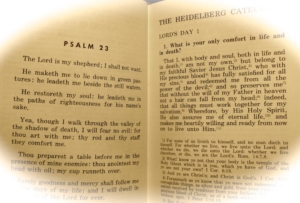
If I may start with something I posted a few weeks ago: The English noun, “misery” is probably derived from the Latin verb misereo, “to pity.” The Latin adjective miser means “wretched.” In our translation, the noun “misery” (German, Das Elend; Latin, . . . Continue reading →
(Reformed) Christianity and (Quasi-Reformed) Revisionism

In his brilliant work, Christianity and Liberalism (1923), J. Gresham Machen called for the “liberals” (many of whom could just as aptly be called broad evangelicals) to be honest about their views and to leave the Presbyterian Church. Thirteen years later, it . . . Continue reading →