CONSIDERATION TWO. That though a ministerial succession should be granted to be drawn through the Church of Rome, and that from the days of the first apostasy in that church to the times of Protestant Reformation, yet thereby the truth of that . . . Continue reading →
Recovering the Reformed Confession
Recovering A Vital Truth About Preaching: It Is God’s Ordained Means To Bring Sinners To Faith
…One of the most helpful things ever written on the question of faithfulness and effectiveness in preaching comes from the “Directory of Public Worship” published and authorized in 1645 by the Assembly of Divines at Westminster and subsequently adopted by the General . . . Continue reading →
How Should A Lay Christian Learn Theology?

Introduction Christians regularly ask for book recommendations and of those, “which systematic theology should I read?” is among the more frequent. The assumption of the question, however, should be doubted: that the best place to begin to learn Christian theology is with . . . Continue reading →
Another Way The Reformed Confessions Can Help Us If We Let Them
I am in the studio today to work on an Office Hours podcast for May so there is just time for a quick thought about another way the Reformed confessions can help the churches be more faithful. Continue reading
Why Are Confessionalists Just A Niche?
That was one of the questions I asked in Recovering the Reformed Confession. Continue reading
New In Print: Recovering The Reformed Confession In Indonesian

Just in, this note from P&R Publishing: “We are pleased to present to you two copies of the Recovering The Reformed Confession as published by Momentum Christian Literature in the Indonesia language.” It is available for 120 Rp from the publisher. Thanks to . . . Continue reading →
New In Print: Robert Rollock On Ephesians

Robert Rollock (1555–99) was one of the most significant Reformed theologians in Scotland in the late sixteenth century. He was an important figure in the development of Reformed covenant theology. He received Calvin’s theology and was especially influenced by Caspar Olevianus (1536–87) . . . Continue reading →
For Evangelical And Reformed Folk Contemplating The Canterbury Trail
A number of Baptists some Presbyterian and Reformed folk have announced in the last year or so that they have become Anglican. Continue reading
Why Your Congregation Should Have An Evening Service
For a long time, it was assumed that Reformed churches would hold a service both on Sunday morning and Sunday evening. Although still practiced in many congregations, this pattern is no longer necessarily the expectation or assumption concerning how the Lord’s Day . . . Continue reading →
Now On Sale For $10.00: Beza On The Lord’s Supper
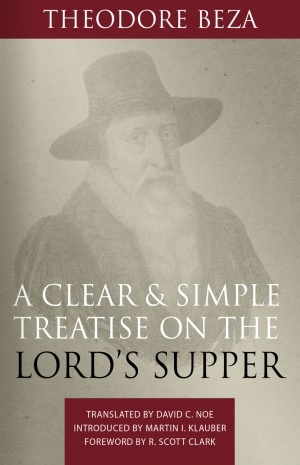
On sale now at Reformation Heritage Books. Beza is one of our most important and yet most under appreciated writers.
Recovering The Lost Treasure Of The Second Service
Unfortunately, these days the heart attitude of this dear elderly woman is almost as rare as the evening service itself. Indeed, over the past twenty years the evening service (in a variety of Christian traditions) has either been turned into a kind . . . Continue reading →
Are Confessions Themselves QIRC-Y?

A correspondent to the Heidelblog writes: …I have been living in the Heidelblog lately, and have been challenged to rethink so many previous convictions. Thank you for this resource! I especially have been edified by the QIRC/QIRE idea, but thinking through it . . . Continue reading →
Crisp: Edwards Was A Panentheist
…Such a picture of God’s relation to the creation is undoubtedly striking, combining as it does aspects of classical theism, theological aesthetics, panentheism, and the doctrines of continuous creation and occasionalism (about which, more presently). Far from being the product of some . . . Continue reading →
More On Edwards, Affections, Romanticism, And Pantheism
If there is a prevailing commonplace about the Romantics it is to associate them with a close and tender regard for nature. And it is true that the relating of human being to being generally considered was so central in their minds, . . . Continue reading →
Criticizing Edwards On Religious Affections Does Not Lead To Dead Orthodoxy: There Is Another Way

In the wake of my latest essay, which cautions readers regarding Jonathan Edwards, has come questions about the role of affections and emotion in the Christian life. These questions signal how deep the Pietist tradition (see the resources below) runs in American . . . Continue reading →
Three Vital Questions For the PCA In 2021
There are three great questions to be faced by the PCA in 2021: Continue reading
Jon Payne: The PCA Is In Trouble
A growing number of our ministers and churches are conforming to the world’s values, attitudes, and ideals, especially as it concerns homosexuality and the social gospel. The future doesn’t look good for the PCA. Frankly, the future looks pretty bad, and I’m . . . Continue reading →
Christmas Confusion
Dear NAPARC Pastor,
If you think that distinguishing law from gospel is “Lutheran” Continue reading
Warning About A Secret Organization In A Conservative Presbyterian Denomination
Very few laymen are aware of the fact that over the last 15 years there has been a secret organization in our Church working quietly behind the scenes to gain control of the political machinery of our denomination. This group, composed mostly . . . Continue reading →
Christian School In Oregon Sues Governor Over Unequal Treatment
After nearly two months of advising that Hermiston Christian School could provide in-person instruction to the 51 students enrolled in its K-12 program, Brown reversed course and, on July 29, ordered private schools in Umatilla County and elsewhere to remain closed while . . . Continue reading →