
Humans seem to be naturally drawn to niceness. Niceness is comfortable. To be nice is to be pleasant in manner, to be agreeable, to adhere to social conventions. We like to be around people who are nice at least in large part . . . Continue reading →
2012 Archive
The Myth of “Christian America”
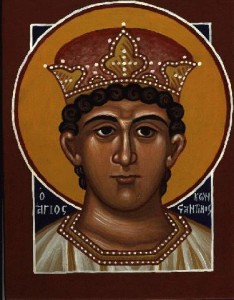
Every four years (and in the interim) the question of whether we should regard the USA as a “Christian” nation re-emerges. There are three ways in which this question might be considered, sociologically, historically, and biblically-theologically. Under each rubric the case for . . . Continue reading →
Has Rome Really Changed?

Chris Castaldo (HT: Justin Taylor) takes issue with R. C. Sproul’s claim: The indisputable fact is that Rome made a number of strong, clear theological affirmations at the Council of Trent. Because Trent was an ecumenical council, it had all the weight . . . Continue reading →
Office Hours: Fesko on Galatians
The latest Office Hours is just out. In this episode Office Hours talks with John Fesko, Professor of Systematic Theology and Historical Theology at Westminster Seminary California, about his new commentary on Galatians. We talked about the setting of Galatians (when, where, to . . . Continue reading →
2K-Kuyperian Rapprochement at Covenant College

Mike Horton, my colleague at WSC, spoke recently at Covenant College (Lookout Mt, GA) on the connections between a two-kingdoms analysis and the various neo-Kuyperian approaches to the relations between Christ and culture. Matt Tuininga was there and filed this report at . . . Continue reading →
Straining at Hermeneutical Gnats and Swallowing Exegetical Camels

Kathy Keller has reviewed the new book by Rachel Held Evans, A Year of Biblical Womanhood. Held Evans is frustrated with evangelical “complementarianism” so she set out to live as if there were no New Testament and as if Jesus’ hadn’t fulfilled . . . Continue reading →
Must We Change Our Theology to Vote for Mitt?

Veteran readers of the HB may remember that I expressed concern in 2009 over a comment by William Evans, The Younts Professor of Bible and Religion at Erskine College, about what he called the need for a “decisive break with the ordo . . . Continue reading →
Jacques Barzun Lived 104 Years

That’s remarkable. I didn’t know he was still alive. All my copies of his books are decades old. When I learned this morning that he died yesterday I was ashamed of myself that I had read so little. Barzun is one of . . . Continue reading →
Isaiah 54-55 and the Well-Meant Offer of the Gospel

Hywel Jones is a dear friend but more importantly he is a dear preacher of the Gospel. In chapel on Tuesdays he’s been preaching through Isaiah 55 focusing on the well-meant, sincere, offer of the gospel. Here’s a recent message. Here are . . . Continue reading →
Catching Up: Office Hours Went to the Desert in Season 3
Last season Office Hours went to the desert. The theme for the season was “Desert Island Books.” I sat down with each member of the faculty to talk about those five books each faculty would want with himself were he stranded on a . . . Continue reading →
Sister Aimee Lives!

Cal Thomas has a column in the October 12 issue of WORLD magazine on one of the more important figures in the history modern American Christianity, Sister Aimee Semple McPherson. Thomas writes, Aimee was more famous than any TV evangelist today. She . . . Continue reading →
Audio: A Plan, A Plague, and a Passover (Ex 12:1-13, 29-32)

A Plan, A Plague, and A Passover.
PCA Commission: There Should Be A Presumption of Guilt

The Standing Judicial Commission of the Presbyterian Church in America ruled that the Missouri Presbytery erred when it failed to find a strong presumption of guilt that [Teaching Elder] Jeffrey Meyers holds views contrary to the Westminster Standards (BCO 34-5) when it . . . Continue reading →
We Are Not Heretics or Schismatics
It is not because we have renounced any article of the catholic faith. We are not heretics. We cordially receive all the doctrines contained in that Symbol which is known as the Apostles’ Creed. We regard all doctrinal decisions of the first six ecumenical councils to be consistent with the Word of God, and because of that consistency, we receive them as expressing our faith. We therefore believe the doctrine of the Trinity and of the person of Christ as those doctrines are expressed in the symbols adopted by the Council of Nicea AD321, that of the Council of Constantinople AD381 and more fully that of the Council of Chalcedon AD451. Continue reading →
The Problem of Friendly Fire
some of the most acute and chronic relational hurts Christians experience is within the believing community. Continue reading →
When the Coin Coffer Clinks, the Cost of Bandwidth Shrinks

Cheesy yes, but you won’t forget it will you? The HB is self-hosted but you can help the HB defray the cost of renting space on the computer and of bandwidth (the cost of accessing a web page). There are no ads on . . . Continue reading →
Office Hours: Dennis Johnson on Hebrews 1-2
Dennis Johnson picks up where Steve Baugh left off in our discussion of the book of Hebrews. This episode features Dr. Dennis Johnson, Professor of Practical Theology, who begins where Steve Baugh and I left off. Dennis is Professor of Practical Theology . . . Continue reading →
Central Valley Conference on Reformed Theology Nov 2-3 2012

Join Bob Godfrey and me for the Central Valley Conference on Reformed Theology, November 2-3, at Zion URC in Ripon, California. Things kick off Friday evening at 7:30PM. Bob Godfrey will answer the question: Is the Reformation Over? He says “Yes!” On . . . Continue reading →
The Impetrative Offer of the Gospel in Isaiah 55

“‘Come to me a you who are weary and heavy laden and I will give you rest’ or ‘I will be your rest.’ How good are we at pleading with people? Do people get the impression from us not only that there is a feast but that God wants them there and that you want them there?” Continue reading →
The Power of Faith: 450 Years of the Heidelberg Catechism

In 2013 the Heidelberg Catechism will be 450 years old. To mark this event Karla Apperloo-Boersma and Herman Selderhuis have edited a new volume (hardcover, 440 pages) on the catechism. According to Amazon it’s $56.00 (HT: Michael A. G. Haykin). Thus begins the . . . Continue reading →