

Those not well read in sixteenth- and seventeenth-century Reformed theology might be forgiven their ignorance of the covenant of redemption or for concluding that it is an arcane doctrine long abandoned. Continue reading →
Those not well read in sixteenth- and seventeenth-century Reformed theology might be forgiven their ignorance of the covenant of redemption or for concluding that it is an arcane doctrine long abandoned. Continue reading →
At first sight, covenantal nomism may seem to be strongly supported by the analogy of a marriage relationship that the Old Testament uses to describe the relationship between the Lord and Israel. Continue reading →

I was searching for something the other day and ran across chapter 18 of the Scots Confession (1560) which speaks to the “Notes” (from the Latin, nota or “mark” or “indicator”) of the True Kirk (church). Ordinarily, when I think of the . . . Continue reading →

In this episode, Dr. Clark continues the Heidelcast series on Romans, beginning with a look at the “New Perspective on Paul” (NPP) and the question of Jews and Gentiles in the early church. Dr. Clark breaks down how the NPP affects Reformed . . . Continue reading →

When I was a student at Westminster Seminary California, I once ordered a used volume of the Nicene and Post-Nicene Fathers series online. When the package arrived, I was surprised to discover that in its place I had been shipped a commentary . . . Continue reading →
I merely want to focus our attention on what I think is the most detrimental theological claim advanced in this book. Wright polemicizes by arguing that we should change the famous line “justification by faith” to “justification by loyalty.” He reasons, “If . . . Continue reading →
We turn now at last to Romans. The first occurrence of ἔργα νόμου is in 3:20: διότι ἐξ ἔργων νόμου οὐ δικαιωθήσεται πᾶσα σὰρξ ἐνώπιον αὐτοῦ, διὰ γὰρ νόμου ἐπίγνωσις ἁμαρτίας. Dunn explains ἔργα νόμου here as meaning quite specifically those observances . . . Continue reading →
What this all means is that justification is God’s final judgment. As Wilfried Joest writes, “there is no second decision after justification.” In the language of the Reformation, the “sole and sufficient basis” for our justification before God’s eschatological tribunal is Jesus . . . Continue reading →
That the observances of the old law are better called signs than sacraments. For those things which were instituted only for the sake of signifying are merely signs, and not sacraments; such were the carnal sacrifices and the ceremonial observances of the . . . Continue reading →

I was searching for something the other day and ran across chapter 18 of the Scots Confession (1560) which speaks to the “Notes” (from the Latin, nota or “mark” or “indicator”) of the True Kirk (church). I’ll return to the Scots Confession . . . Continue reading →
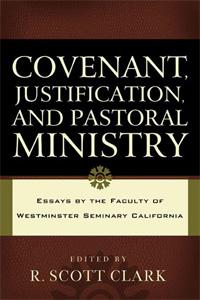
Apropos of recent discussions on the HB P&R Publishing has released CJPM as an e-book on iTunes for $9.99. The hardcopy is still available for $18.99 at the bookstore.

Or maybe not. For years people have said to me, “Well, Wright isn’t very good on justification but he’s solid on the resurrection and the deity of Christ.” The implication of this argument is that Wright is a well-placed, influential member of . . . Continue reading →
That’s what N. T. Wright proposes. Remarkably, a number of evangelical and Reformed folk seem ready to accept Wright’s re-definition of justification or, in some cases, to downplay the consequences of Wright’s re-definition. Wright says: “‘Justification’ in the first century was not . . . Continue reading →

In 1963, Krister Stendahl published a seminal essay in a movement that was to become known as the New Perspective on Paul (hereafter NPP), “The Apostle Paul and the Introspective Conscience of the West.” As Michael Kruger writes, Stehdahl argued “the traditional . . . Continue reading →

The latest episode of Office Hours is up and it is a discussion with Prof. Guy Waters about the nature of the New Perspectives on Paul and the nature of the self-described “Federal Vision,” movement. We talk about what Paul really said . . . Continue reading →
It’s become clear in recent months that the FV/NPP controversies in the broader evangelical and Reformed worlds haven’t gone away. A leading congregation in the Gospel Coalition has implicitly endorsed N T Wright by having him speak to a church-sponsored gathering. There . . . Continue reading →
In Christianity Today. Is Wright correct when he asserts “Basically, the whole idea of virtue has been radically out of fashion in much of Western Christianity ever since the sixteenth-century Reformation”? Could anyone read any of the Reformed literature from the 1530s . . . Continue reading →
UPDATE A PCA Ruling Elder in NYC reviews Wright’s appearance and raises some of the same concerns that I raised about the wisdom of Redeemer inviting NTW to speak at Redeemer NYC. Original Post 25 Mar 2010 He’s appearing under the auspices . . . Continue reading →
The latest issue of Tabletalk (Feb, 2010) devoted to answering the question: “What N.T. Wright Really Said” as it looks at the controversy surrounding N.T. Wright and the doctrine of justification. Tabletalk is a devotional magazine of substance featuring a remarkable array . . . Continue reading →
When I was in college the BSU (Baptist Student Union) was the place to meet nice Christian girls, Crusade was for evangelistic-minded types, Navigators was for spiritual discipline, and Inter-Varsity (IV) was for intellectuals. IV was clearly associated with the historic, confessional . . . Continue reading →