One aspect of our new life in Christ to which modern evangelical and Reformed Christians have not always paid a great deal of attention is the matter of virtue. There are some good reasons for this. The medieval church came to think . . . Continue reading →
Author: R. Scott Clark
R.Scott Clark is the President of the Heidelberg Reformation Association, the author and editor of, and contributor to several books and the author of many articles. He is professor emeritus of church history and historical theology at Westminster Seminary California, where he taught for 29 years. He also taught at Wheaton College, Reformed Theological Seminary, and Concordia University. He has hosted the Heidelblog since 2007 and the Heidelcast since 2009.
Taking Notes By Hand Works Best
Pop quizzes, of course, are not the best measure of learning, which is an iterative and reflective process. Recent Princeton University and University of California studies took this into account while investigating the differences between note-taking on a laptop and note-taking by . . . Continue reading →
The Shield Of Works? Faith, Spiritual Warfare, And Salvation
The preacher this morning read from Ephesians 6 and Paul’s expression in 6:16 struck me relative to the current discussion about works and salvation. There is no question whether believers will do good works or whether those good works are evidence of . . . Continue reading →
Augustine On Romans 2:13
Now he could not mean to contradict himself in saying, “The doers of the law shall be justified,” as if their justification came through their works, and not through grace; since he declares that a man is justified freely by His grace . . . Continue reading →
Calvin On Romans 2:13 In His Institutes
That they indeed quote Paul in the same sense does them very little good: “The doers of the law, not the hearers, are justified” [Rom. 2:13 p.]. I do not intend to evade the question through Ambrose’s solution: that this was said . . . Continue reading →
20th Anniversary Of Exiles From Eden
Readers and others sometimes ask which books have influenced the way I look at this or that. Sometimes I can answer, sometimes I can’t. One influential book that I read early in my academic career, while I was a graduate student, was . . . Continue reading →
Witsius And Turretin On The Necessity And Efficacy Of Good Works In Salvation
Introduction There is no question among orthodox, i.e., confessional, Reformed folk whether good works are necessary as a consequence, evidence, and a fruit of justification and sanctification by grace alone, through faith alone. There is no question whether God’s moral law, whether summarized in . . . Continue reading →
Charles Hodge On Romans 2:13
VERSE 13. For not the hearers of the law. This verse is connected with the last clause of the preceding, and assigns the reason why the Jews shall be judged or punished according to the law; the mere possession or knowledge of . . . Continue reading →
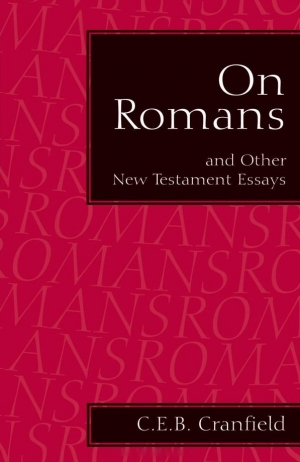
Free: Cranfield On Romans And Other NT Essays (UPDATED)
I’m just getting beginning to use and getting to know Logos. They are offering a free copy of C. E. B. Cranfield’s On Romans And Other New Testament Essays. This is a valuable resource. Cranfield’s 1975 ICC commentary remains a standard reference . . . Continue reading →
Get This Outstanding Book FREE
When, in 1994, Carl Trueman kindly invited me to co-edit Protestant Scholasticism: Essays in Reassessment there was no such modern introduction to what had long been a forgotten or misrepresented period of Protestant theology. Since the publication of PSER (1998), there have . . . Continue reading →
Tribalists All
We may conclude, apparently, that Merritt favors cosmopolitanism to sectarianism. But what sense does this make of biblical calls for God’s people to isolate themselves. The Israelites weren’t exactly interested — or weren’t supposed to be — in a Jerusalem that featured . . . Continue reading →
Notes From URCNA Synod Visalia 2014
Reporting from URCNA Synod in Visalia, California. In Reformed church government there are four deliberative bodies that make decisions, a consistory (ruling elders and ministers of a local congregation), a council (ruling elders, ministers, and deacons of a local congregation), classis (a . . . Continue reading →
Romans 2:13—Justified Through Our Faithfulness? (4)
In part 3 we began looking at a document, from 1978, which proposed a two-stage doctrine of justification. It recognized that there is some risk, some difficulty, in speaking of a present justification and a future justification. Nevertheless, the document contends that . . . Continue reading →
Calvin Shows Up In The Oddest Places
Calvin’s Commentary On Romans 2:13
…they gloried in the mere knowledge of it: to obviate this mistake, he declares that the hearing of the law or any knowledge of it is of no such consequence, that any one should on that account lay claim to righteousness, but . . . Continue reading →
Luther’s First Lecture On Romans 2:13 (1515–16)
13. But the doers of the Law will be justified. This passage is interpreted in a twofold way by blessed Augustine in chapter 26 of On the Spirit and the Letter. First in this way:The doers of the Law will be justified means that through . . . Continue reading →
Romans 2:13—Justified Through Our Faithfulness? (3)
In part 2 we considered Romans 2:13 in its own context (Romans 1:18–3:20) and the impulse to distinguish between an initial stage of justification sola gratia, sola fide, on the basis of Christ’s righteousness imputed, and a final stage of justification in . . . Continue reading →
Romans 2:13—Justified Through Our Faithfulness? (2)
In part 1 we began looking at a neglected aspect of the current controversy over justification and sanctification. What has been neglected is a 1978 proposal that, at the judgment, “faithful disciples” will be justified before God through their faithfulness. The current controversy . . . Continue reading →
Romans 2:13—Justified Through Our Faithfulness?
As I mentioned in an earlier post in Romans 2:13 Paul writes, “For it is not the hearers of the law who are righteous before God, but the doers of the law who will be justified” (ESV).1 The chapter begins with matter of . . . Continue reading →
Colquhoun: Repentance Does Not Give Us Title To Eternal Life
How then can his repentance atone for his iniquities, or entitle him to the favour of God and to the happiness of heaven? How can that evangelical repentance, which he is incapable of exercising till after his sins be all forgiven on . . . Continue reading →