Now, to be justified is to be freed from the guilt of sin, or to have all our sins pardoned, and to have a righteousness wherewith to appear before God, so as to be accepted with him, and a right to the . . . Continue reading →
Justification
John Piper, Future Grace: The Purifying Power of the Promises of God, rev. ed. (New York: Multnomah, 2012)—A Thorough Review
Pastor John Piper is well-known for his role in sparking the “young, restless, and Reformed” movement, mainly through his emphases on God’s sovereignty and serious expository preaching. There are no doubt numerous present members of Reformed churches who ended up there because of initial investigations of Reformed theology that began with hearing or reading John Piper. Personally, Piper was my first exposure to a thorough and biblical explanation of predestination in some of the appendices of the 2003 edition of Desiring God, which I was told to read shortly after becoming serious about my faith. Continue reading →
What Do We Mean When We Say That Jesus Hung Out With Sinners?
Jesus reclines at the feast of Levi, and he is surrounded by more tax-collectors and sinners. He is keeping company with some bad folk. To be labeled a sinner was not to be socially misunderstood; it wasn’t an unfair prejudice against those . . . Continue reading →
Heidelcast 202—What Must A Christian Believe? (19): The Forgiveness Of Sins (1)
This is episode 19 in the series, What Must A Christian Believe? In our survey of the rule of faith, i.e., the Apostles’ Creed, we have reached the tenth article, “the forgiveness of sins.” That phrase does not occur in the earliest . . . Continue reading →
William Perkins On Justification
Perkins objected to Rome’s sacrifice of the Mass. For Perkins, this doctrine was attached to erroneous views of Christology, Christ’s propitiatory suffering unto death, and in turn the doctrine of justification. One of Perkins’s clearest Christological statements is found in his treatise, A Warning Against the Idolatry of the Last Times (1601), where he wrote, “For He in one person is perfect God and perfect man, our only Redeemer all-sufficient in Himself, and therefore perfect king, priest, prophet; without either partner or fellow in the work of man’s salvation.” Continue reading →
Heidelcast 204—What Must A Christian Believe? (20): The Forgiveness Of Sins (2)
This is episode 20 in the series, What Must A Christian Believe? In our survey of the rule of faith, i.e., the Apostles’ Creed, we have reached the tenth article, “the forgiveness of sins.” The truth of our righteousness with God is essential . . . Continue reading →
Heidelcast 205—What Must A Christian Believe? (21): The Forgiveness Of Sins (3)
This is episode 21 in the series, What Must A Christian Believe? In our survey of the rule of faith, i.e., the Apostles’ Creed, we are completing our brief study of the tenth article, “the forgiveness of sins.” The doctrine of justification . . . Continue reading →
Owen: The Loss Of Justification Sola Fide Leads To Rome Or Atheism
I shall take the boldness, therefore, to say, whoever be offended by it, that if we lose the ancient doctrine of justification
James Does Not Contradict Paul And Vindication Is Distinct From Justification
And There Is Plenty Of Courtroom Language In The New Testament
Why did James say “justify” if he did not mean to indicate that there is either a second way of justification (e.g., by works) or if he did not mean to signal that works somehow play some role other that fruit and evidence. Continue reading →
With The Pactum Podcast On “Do This And Live”
Pat Abendroth is a friend and pastor of Omaha Bible Church and the host of The Pactum Podcast. Pactum is a Latin noun for covenant. You might see or hear it used, e.g., to refer to the pactum salutis, the covenant of redemption between . . . Continue reading →
Perkins: As Soon As One Believes
For so soon as a man believes, he is presently justified. For every believer has… Continue reading →
Trent Is Nature, Heidelberg Is Grace
We all naturally hold to the article of justification expressed in the Council of Trent, Continue reading
Romans 5:9–10: You Were Justified And You Shall Be Saved Sola Gratia, Sola Fide
For many evangelicals and for some ostensibly Reformed folk it has been fashionable for the last several years to teach that we are justified now by grace alone (sola gratia), through faith alone (sola fide), on the basis of Christ’s righteousness imputed . . . Continue reading →
Haldane: “Ungodly” In Romans 4:5 Means What It Says Just As “Works Not” Means What It Says
Ver. 5. —But to him that worketh not, but we leave it on him that justifies the ungodly, his faith is counted for righteousness. But to him that worketh not.—This is entirely misunderstood by Dr. Macknight and Mr. Stuart, as if it . . . Continue reading →
On Justification In Romans And Hebrews
One does not often think of Hebrews when it comes to the doctrine of justification—we normally go right to Paul’s writings. Continue reading
Trent’s Knowing And Intentional Rejection Of Justification Sola Fide
After theologians the bishops took the floor, song speaking for two or more hours at a time. Some were well-versed in the subject. Their approach, like that of theologians, was generally framed by Scholastic categories, and, despite Pole’s words, they often seemed . . . Continue reading →
Heidelcast 222: A Question & Answer Cornucopia
In this episode Dr Clark answers Heidelcalls, texts, and mails with questions, questions, and more questions from 1) Aaron about “covenant renewal worship” (is this a “federal vision” thing or may orthodox Reformed Christians talk this way?); 2) Ritchie (from Ireland) about . . . Continue reading →
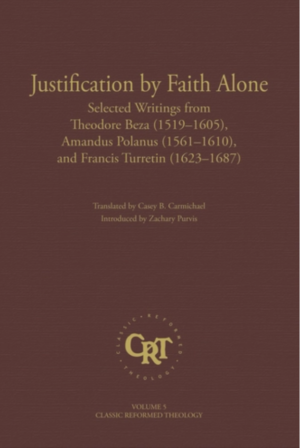
Coming In December, 2022: Beza, Polanus, And Turretin On Justification
From its inception, the goal of the Classic Reformed Theology Series from Reformation Heritage Books (sponsor of the Heidelcast) has been to present, in English, primary source texts in Reformed theology. This new volume is the sixth in the series, which began . . . Continue reading →
Piper’s New Book Is Edwardsian
The major—and expected—exception is Jonathan Edwards, whose view of faith no doubt stands behind Piper’s approach to this issue. Edwards believed that love is at the heart of faith: “That even faith, or a steadfastly believing the truth, arises from a principle . . . Continue reading →
Faith Formed By Love Or Faith Alone? The Instrument Of Justification
In his discussion of works, Calvin anticipates the great error of many contemporary critics of the Reformation doctrine. They think that as long as they say that salvation is by grace alone they have said all they need to say theologically, but many medieval theologians said exactly that. They taught that grace alone worked to transform and sanctify the life and that all the works of the Christian are the fruit of grace. Such an improved life, however, is still an imperfect life and cannot stand in the judgment. Calvin summarizes the situation succinctly: “If righteousness is revealed in the gospel, surely no mutilated or half righteousness but a full and perfect righteousness is contained there. The law therefore has no place in it” (Institutes 3.11.19). What one needs to stand in the judgment, Calvin declares over and over again, is a perfect righteousness. No matter how much progress one makes in grace during this life, so that one’s life becomes holier, holier, and holier, it will never get to the point where it will be able to stand in the judgment. Continue reading →