[Originally published March 6, 2010] In view of a recent post by Carl Trueman concerning virtual preachers now seems a good time to republish this HB classic. § Two jarring facts came to my attention in recent days. The first of these is . . . Continue reading →
American Christianity
Protestants Looking For Authority Convert to Rome
As part of trend, which has been observed here since October 2009, a retired Episcopal minister, Larry Gipson, has become a Roman priest. Gipson was formerly the rector of the USA’s largest Episcopal church. He’s in process of becoming a Roman priest . . . Continue reading →
America is Exceptional
In the previous post I tried to give some context to the claim that the USA is a “Christian” nation. There are ways in which that adjective is accurate and important ways in which it is not. Sometimes, however, when folk call . . . Continue reading →
The Myth of “Christian America”
Every four years (and in the interim) the question of whether we should regard the USA as a “Christian” nation re-emerges. There are three ways in which this question might be considered, sociologically, historically, and biblically-theologically. Under each rubric the case for . . . Continue reading →
Straining at Hermeneutical Gnats and Swallowing Exegetical Camels
Kathy Keller has reviewed the new book by Rachel Held Evans, A Year of Biblical Womanhood. Held Evans is frustrated with evangelical “complementarianism” so she set out to live as if there were no New Testament and as if Jesus’ hadn’t fulfilled . . . Continue reading →
Sister Aimee Lives!
Cal Thomas has a column in the October 12 issue of WORLD magazine on one of the more important figures in the history modern American Christianity, Sister Aimee Semple McPherson. Thomas writes, Aimee was more famous than any TV evangelist today. She . . . Continue reading →
Why the “Nones” Are Growing
USA Today has a story on recent Pew Forum survey that shows that 48% of Americans are “Protestant,” 22% Roman, and 20% are slotted under “none,” and 6% under “other” (the greater share of which one guesses is Islam, which is gaining . . . Continue reading →
Puritans, Slavery, and Criticizing Heroes
Thabiti Anyabwile has a stimulating and thoughtful post about a controversy that, except for the interwebs, I would have missed altogether. It apparently arose over a rap song. Hence my ignorance. Now, if was Al Green, Booker T. and the MGs, or . . . Continue reading →
Colson Calls for Doctrinal Boot Camp: But Which Doctrine?
In 1994 Chuck Colson attempted to convince evangelicals that the decline of the culture was so precipitous that they needed to set aside the historic Protestant doctrine of justification in favor of an intentionally equivocal statement about how we are accepted by . . . Continue reading →
Radon Thoughts Is Reading Always Reformed
He likes the essay about Sister. Read more».
Collin Hansen on Evangelical "Self-Inflicted Amnesia"
Sometimes younger Christians give the impression that we have things figured out. We’re the future. We’ve found the old methods wanting, so we’ve developed new ones. We’re the generation that will strike the right balance where our forebears fell over to one . . . Continue reading →
Is the Reformed Faith a Second Blessing?
In response to Jason Stellman’s monday post the question has arisen as to what should be required for membership in a confessional Reformed (e.g., Three Forms) or Presbyterian (Westminster Standards) congregation. The argument has been made that, in American Presbyterian churches, the . . . Continue reading →
Clark Pinnock Dies at Age 73; Was God Surprised?
Too soon? Bad taste? Perhaps but so is suggesting that God might have a body (see Most Moved Mover) and that the future is “genuinely open” to God. As soon as I read of Pinnock’s death in Christianity Today the first thing . . . Continue reading →
Anne Rice is Right (and Wrong)
I understand why Anne Rice has renounced (HT: Aquila Report) the visible, institutional church. She’s a modern and she’s an American. She might also have some “authority issues” (she was born “Howard Allen O’Brien“) but I digress. Yes, she’s Romanist but she’s . . . Continue reading →
Audio Resources: The Presbyterian and Reformed Family Tree
Ever wonder whence the split Ps and broken Rs come? Here’s a great interview with WSC’s Darryl Hart on the Presbyterian and Reformed family tree.
Horton: To Be or Not to Be? Reformed Christianity And American Evangelicalism
Somewhere along the way, however, the evangel became increasingly separated from evangelism; the message became subservient to the methods. Today, it is taken for granted by many that those most concerned about doctrine are least interested in reaching the lost (or, as . . . Continue reading →
The Presbyterian Guardian is Back (Link Corrected)
Well, the back issues are now available online (HT: Josh Martin)
Neither Abyss Nor Eschaton
David Hall analyzes the just past PCA GA. I found it helpful.
Hegel in the PCA?
It seems like a dialectic. It’s almost a minimalist definition of “Reformed” and Darryl has some interesting analysis of it.
EPC Moves Toward the Mainline and the Mainline Moves Toward the Drain
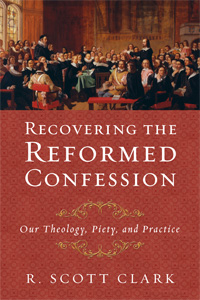
Recovering the Reformed Confession I described the Evangelical Presbyterian Church (along with the CRC) as a part of the “borderline” (as distinct from the mainline and the sideline). At the time, the CRC appeared to be moving toward the mainline (which trajectory . . . Continue reading →