In October of 1545, Heinrich von Wolfenbüttel (1489–1568), the Romanist Duke of Braunschweig-Lüneberg-Wolfenbüttel, in the process of a attempting to recover lands taken from him by the Protestant Schmalkald League (in 1542), was taken captive along with his sons. The Lutheran territories . . . Continue reading →
Historical Theology
Where Were The Church And The Truth Between The Fathers And The Reformation?

Johnny Carson was a kid from Nebraska, who hosted The Tonight Show from 1962–92. One of his more famous recurring gags was Carnac the Magnificent, ostensibly a magician—Carson had a magic act as a high school and college student—who was able to . . . Continue reading →
Engaging With 1689

Recently I had opportunity to engage in a friendly dialogue with some Baptist academics over the merits of the project proposed in Recovering the Reformed Confession. That project is, as they say, wending through the publication process. Because of space limitations I was unable to do a couple of things, namely, to engage more fully with some of the texts and approaches to Baptist covenant theology (as distinct from Reformed covenant theology). Continue reading →
In Defense Of Creedalism

Thanks to Gary Johnson for forwarding to me a recent essay by Roger Olson, who is Foy Valentine Professor of Christian Theology of Ethics at George W. Truett Theological Seminary of Baylor University. In that essay, “Against Creedalism: Why I Am A . . . Continue reading →
Heidelcast 129: I Am That I Am (7)—The Trinity In The New Testament

Augustine of Hippo used to say that what was concealed in the Old Testament is revealed in the New Testament and that is certainly true in case of the biblical doctrine of the Trinity. As we have discussed so far in the . . . Continue reading →
Where Is The Church Heading? (2)

From time to time, Protestants have been tempted to think that the Roman communion has been dealt a fatal blow. History, however, tells us that though she has been wounded from time to time, she always returns. However vigorous the Reformed churches may be in some parts of the world (e.g., Brazil, South Korea, and Nigeria) the confessional Presbyterian and Reformed churches in North America (NAPARC) are tiny compared to the Roman communion. Continue reading →
Video: The Glass Ceiling Cracked (How The Reformation Happened)

Video courtesy the Lynden United Reformed Church (Lynden, WA) where Bob Godfrey and I spoke earlier this month for their Reformation Conference: Luther Nailed It.
The Freedom Of The Christian Man

There is a great lot of talk in the evangelical and Reformed world(s) about sola Scriptura but one has the growing sense that not only is the Reformation scripture principle not well understood (e.g., it is often misconstrued as an endorsement of . . . Continue reading →
Luther On His State When He Wrote The 95 Theses In 1517
But above all else, I beg the sincere reader, and I beg for the sake of our Lord Jesus Christ himself, to read those things judiciously, yes, with great commiseration. May he be mindful of the fact that I was once a . . . Continue reading →
Witsius: Among The Various Acts Of Faith Is Union With Christ
It seems proper, in the mean time, to remark that, amongst the various acts of faith which we are about to describe, there is one which holds the principal place, and in which, as it unites us to Christ and justifies us, . . . Continue reading →
Office Hours: Aquinas Among The Protestants

Thomas Aquinas (c.1224–74) was one of the most important Christian teachers in the period and though he was eclipsed in the centuries after, his work returned to prominence in the 16th–19th centuries particularly among Roman theologians, for whom Thomas became the theologian . . . Continue reading →
Theology And The University In Nineteenth-Century Germany

The history of modern German theology is dominated by two figures, Friedrich Schleiermacher (1768–1834) and G. F. W. Hegel (1770–1831) but there is more to the story. If Schleiermacher and Hegel formed the skeleton, a series of lesser-known figures and institutions formed . . . Continue reading →
On Memorial Day: All Christians Are Historians

In the United States, Memorial Day is day for remembering those who died in the service of the US military. It began as Decoration Day in 1868, on which day 5,000 people decorated the graves of Union and Confederate soldiers at Arlington . . . Continue reading →
Turretin On The Fundamental Articles Of The Faith
I. The question concerning fundamental articles is difficult and important. It has been discussed by many who have erred both in defect and in excess. The Socinians err in defect who admit very few fundamentals (and those only practical, theoretical being almost . . . Continue reading →
Are The Remonstrants Heretics?

This question comes over the transom regularly. I think most confessional Reformed pastors would probably say that, though they disagree strongly with Arminianism, it is not heresy. Somewhere I read (or heard) that William Ames (1576–1633), who served as an advisor . . . Continue reading →
The Dramatic Story Of Peter Martyr Vermigli
Pope Paul III, however, was not sitting idle in this rapidly changing climate. In 1542, after a failed attempt to conciliate Roman Catholics and Protestants at the Diet of Regensburg, he agreed on renewing the earlier practice of the Roman Inquisition under . . . Continue reading →
Augustine’s Retractations, Perfectionism, And Fakespectations (2)

Secular institutions and even extra-ecclesiastical Christian institutions have always been, in their essence, law. The civil magistrate may exercise mercy—Calvin’s first published work was a commentary on Seneca’s De Clementia (On Clemency), Seneca’s defense of the virtue of mercy to Nero. When . . . Continue reading →
Augustine’s Retractations, Perfectionism, And Fakespectations (1)
For a long time I have been thinking about and planning to do something which I, with God’s assistance, I am now undertaking because I do not think it should be postponed: with a kind of judicial severity I am reviewing my . . . Continue reading →
New: Peter Martyr Vermigli For Children
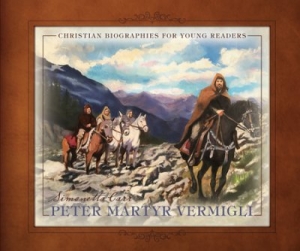
In our age of screens (phones, tablets, computers, watches etc) it is counter-intuitive but nonetheless true to say that books are more important than they have been for a long time. They are more important precisely because our culture is drifting away . . . Continue reading →
Preaching As For The Free

One of the privileges of editing the Classic Reformed Theology series for Reformation Heritage Books is that I get to work closely with significant Reformed texts and shepherd them through the process from translation (e.g., from Latin to English) to publication. Currently . . . Continue reading →