The Confessing Church (Bekennende Kirche) constitutes a movement (from September 1933 onward) mainly within the German Protestant Church, whose very existence helped discredit the doctrinally liberal, extremely nationalistic, and racist anti-Semitic efforts of the “German Christians” (with roots in Prussia and Thuringia) . . . Continue reading →
Christian History
Carl F. H. Henry Against The Nazis
What is widely overlooked today is that a worldview based on naturalistic evolution can provide no reasonable foundation for either the universality or the permanence of human rights; it was precisely such naturalistic theory that underlay the Nazi repudiation of the inherited . . . Continue reading →
Revisionist Confessional History
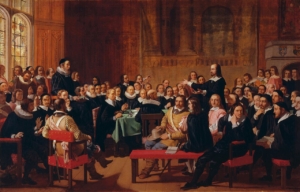
There is an idea floating around that all the teachings of the original version of the Westminster Confession of Faith (1646/1647) are basically included in or assumed by the revised American version of 1788/1789 and that agreeing with/preferring the original is more or . . . Continue reading →
Rethinking the Crusades

The History Channel reminds us that on November 27, 1095, Pope Urban II ordered the First Crusade. Before 1979 it was more difficult than it is today to imagine such a thing, a leader of a world religion ordering a military crusade to conquer . . . Continue reading →
Video: How Disney Facilitated And Monetized Perpetual Adolescence And Created A New Religion Along The Way

In 2025, a woman spent $35,000 on a Disney vacation. She isn’t a billionaire—she is a “Disney Adult.” This video investigates how Disney spent forty years engineering a generation of adults to treat a children’s brand like a religion. In this business . . . Continue reading →
Video: Project Geneva—Law Gospel
Rev. Schexnayder teaches on the relationship between the Law and the Gospel, showing how God’s Law confronts us with the truth about our sin—“through the law comes knowledge of sin” (Romans 3:20)—and reveals our deep need for grace. He points us to . . . Continue reading →
Video: Have Archaeologists Discovered Biblical Bethsaida?
In this video, Shane Rosenthal, host of The Humble Skeptic podcast explores the archaeological dig site at El-Araj on the north shore of the Sea of Galilee and talks with some of the archaeologists working there. Could this be the true location . . . Continue reading →
Only Blood Can Do It
Every sin leaves a stain. Hasty words, undone duties, secret thoughts that rot in the corners of conscience. Water cannot reach them. Resolve’s solvent cannot lift them. Only one blood has power to cleanse what lies beneath the surface of the soul. . . . Continue reading →
The Allure Of The Hidden And The So-Called Lost Gospels
Two years ago—in fall 2023—the internet was abuzz over the publication of an ancient manuscript that seemed to contain material from one of the most famous gospels outside our New Testament: the Gospel of Thomas. The online chatter was immense, which was . . . Continue reading →
Ancient Christian Opposition To Abortion And Infanticide
You must not waver with regard to your decisions. “You shall not take the Lord’s name in vain.” You shall love your neighbor more than your own life. You shall not abort a child nor, again, commit infanticide. You must not withhold . . . Continue reading →
Can Baptists Be Catholic? (Part 3)
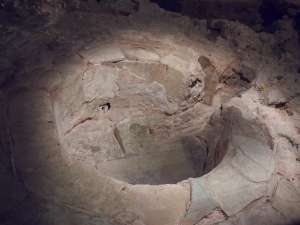
My Baptist friends give two replies to the claim that they are not truly catholic. First, they appeal to their intent to be catholic. For example, in the introduction to the Second London Confession (1689) they say: “This we did the more abundantly to manifest our consent with both in all the fundamental articles of the Christian religion, as also with many others whose orthodox Confessions have been published to the world on the behalf of the Protestant in diverse nations and cities.” Continue reading →
Can Baptists Be Catholic? (Part 2)
When the ancient church began to use the adjective catholic (universal) to describe her theology, piety, and practice, and to distinguish herself from the Gnostic, Marcionite, and Montanist cults of the second century, the best evidence is that they did not read . . . Continue reading →
Anglicanism True And False
Significant numbers of American evangelicals have come to find ancient liturgical forms meaningful, a welcome alternative to the folksy informality typical of many Protestant churches today, especially ‘big-box’ nondenominational congregations. In liturgical churches, these seekers find a stronger historical consciousness and a . . . Continue reading →
Can Baptists Be Catholic? (Part 1)
Whether Baptists can be catholic is a serious question that requires a serious answer. Before we proceed, however, we must define our terms. What is catholicity? Our English word catholic is really a Greek word, katholikos (καθολικός), borrowed by English. What does . . . Continue reading →
Ferguson On Celebrating Christmas
It’s often said that Christmas is actually a pagan holiday based on the Roman holiday of Saturnalia. But that is a bit like saying that Reformation Sunday is a pagan celebration because it coincides with Halloween. Some churches started holding a Reformation . . . Continue reading →
Blood In The Seine: French Christian Nationalism And The St. Bartholomew’s Day Massacre: Part 2

Some of what took place in Paris beginning on August 24 can be explained by sociology and social history. There were real religious and social tensions in Paris and in Roman Catholic dominated towns in 1572. Paris itself was not yet spread out. There were about 210,000 people crowded together. Continue reading →
Blood In The Seine: French Christian Nationalism And The St. Bartholomew’s Day Massacre: Part 1
On August 22, 1572, Gaspard Comte de Coligny (1519–72), Admiral of France, bent to adjust his shoe or perhaps to open a letter. That unexpected movement saved his life. The bullet, fired by Charles de Louviers (d. 1583) from an upstairs window . . . Continue reading →
Prove It
Firstly, the Old Testament (OT) church functioned as a state church grounded in theocratic model of ancient Israel, where God’s Word intertwined religious and civil governance. This is evidenced through the Mosaic Law. There, the church and state were twain made one. . . . Continue reading →
Warfield’s Fist-Fight
Princeton College alumni who remembered Benjamin Breckinridge Warfield’s student days at Princeton recall that on November 6, 1870, the young Warfield and a certain James Steen, “distinguished themselves by indulging in a little Sunday fight in front of the chapel after Dr. . . . Continue reading →
Bartholomaeus Ziegenbalg: The Pioneer-Protestant Missionary

In the wake of the Counter-Reformation and the increasing spread of the Jesuit missions movement, the King of Denmark, Fredrick IV (1671–1730), responded by launching the first Protestant mission. Franz Julius Lutkens, the chaplain to the king, founded the Danish Royal Mission . . . Continue reading →