FIFTH QUESTION: THE UNITY OF THE COVENANT OF GRACE Was the covenant of grace one and the same as to substance under each dispensation? We affirm against the Socinians, Anabaptists and Remonstrants I. This most important controversy is waged by us with . . . Continue reading →
History of Reformed Theology
Ursinus: Christ Was The Author And Mediator Of The Old Covenant
IV. IN WHAT DO THE OLD AND THE NEW COVENANT AGREE, AND IN WHAT DO THEY DIFFER? Since there is but one covenant, and the Scriptures speak of it as though it were two, we must consider in what particulars the old . . . Continue reading →
Brakel: The Substance Of The Covenant Of Grace Is Identical In The Old And New Testaments
The Covenant of Grace Identical in both Old and New Testaments Question #1: When was this covenant of grace initiated? Answer: Due to a misunderstanding concerning the nature of the covenant of grace, the Socinians and Arminians, who are in this respect . . . Continue reading →
Update: John Owen Is Still Not A Baptist
Obs. III. Divine institutions cease not without an express divine abrogation.—Where they are once granted and erected by the authority of God, they can never cease without an express act of the same authority taking them away. So was it with the . . . Continue reading →
The Necessity Of Good Works: Ursinus’ Exposition Of Heidelberg 64

Although the Protestant movement gained political legitimacy with the Religious Peace of Augsburg in 1555, Luther’s reformation had not yet been won. Rome still sought to regain the Palatinate and, by the middle of the 16th century, controversies had already divided the . . . Continue reading →
What The Reformed Can Learn From A 1532 Synod

Introduction In researching the essay on sola scriptura I found myself reading the 44 articles of the Synod of Bern, which was held January 9–14, 1532. In attendance were 230 delegates, including Wolfgang Capito (c. 1478–1541) and William Farel (1489–1565). Two things . . . Continue reading →
Was Sola Scriptura A Reformation Slogan And Doctrine?

Introduction: What Sola Scriptura Is and Is Not Recently, in a couple of places (online and in print) I have run across the claims, which, in different ways question the Reformation bona fides of the slogan and doctrine, sola scriptura. In one place an . . . Continue reading →
Turretin: What We Mean When Call Mary Theotokos, The Mother Of God
XI. Mary is rightly called the Mother of God (theotokos) in the concrete and specifically because she brought forth him who is also God, but not in the abstract and reduplicatively as God. Although this is not expressly stated in the Scriptures, . . . Continue reading →
Caspar Olevian And The Substance Of The Covenant Now $10.00

Caspar Olevianus (1536–87) was an influential figure in the development of Reformed (as distinct from other versions of) covenant theology. He was a student of John Calvin (1509–64) and Theodore Beza (1519–1605). Like them, he was a Roman Catholic humanist scholar who . . . Continue reading →
Perkins: By Nature We Seek To Contribute To Our Salvation But The Gospel….
By nature we desire to stand upright and righteous before God by some good thing in ourselves; as the rich man in the gospel, he demands of Christ, ‘What good thing shall I do to be saved?’ [Matthew 19:16]. Again, it is . . . Continue reading →
Owen: Christians Are In The Same Church As Abraham (3)
And this doth and must determine the difference between the Jews and Christians about the promises of the Old Testament. They are all made unto the church. No individual person hath any interest in them but by virtue of his membership therewith. . . . Continue reading →
Owen: Christians Are In The Same Church As Abraham (2)
It remains, then, that the church founded in the covenant, and unto which all the promises did and do belong, abode at the coming of Christ, and doth abide ever since, in and among those who are the children of Abraham by . . . Continue reading →
Owen: Christians Are In The Same Church As Abraham
And herein is a solemn prefiguration of the implanting of believers of all nations into the covenant and faith of Abraham; for this name he received upon the solemn establishment of the covenant with him, as the apostle explains the place, Rom. . . . Continue reading →
New HB Resource: Articles, Books, Podcasts And More On The Covenant Of Works

We might say that the Reformed doctrine of the covenant of works, or better, adherence to the doctrine, is recovering from an illness. The doctrine itself is fine. It is what it has long been but from the early 20th century until . . . Continue reading →
The Threefold Distinction In the Law Is Basic Reformed Theology
And So Is The Distinction Between Law And Gospel
The law in general, is that part of God’s Word, which commands things just, honest, and godly, and being thus conceived, it is threefold: ceremonial, judicial, and moral. The ceremonial law, is that part of God’s Word, which prescribed to the Jews, . . . Continue reading →
Found: Hardcopies Of Always Reformed

This volume was published in 2010 in celebration of Bob Godfrey’s sixth-fifth birthday. It is a collection of essays by Reformed scholars on a variety of topics. Contributors: Sinclair Ferguson, D. G. Hart, Richard Muller, Michael Horton, Kim Riddlebarger, R. C. Sproul, . . . Continue reading →
Perkins: God Finds In Our Good Works More To Damn Than To Save
Q: How is he accepted righteous before God? A: By the righteousness of Christ imputed to him [2 Col 5:21]. Q: What profit comes by being thus justified? A: Hereby and by no other means in the world, the believer shall be . . . Continue reading →
Heidegger: Good Works Are Necessary As Fruit And Evidence Of Faith
VIII. New Obedience; Good Works New obedience is exercised through good works. Moreover, there are good works, voluntary actions of the sanctified, which come from a pure heart, love of God, true faith in Christ, according to the law of God, for . . . Continue reading →
New In Print: J. H. Heidegger’s Concise Marrow Of Theology
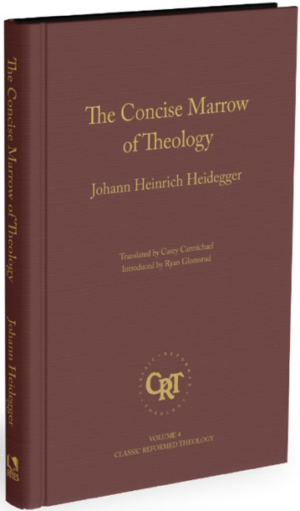
J. H. Heidegger (1633–98) was a significant Swiss Reformed theologian, in Zürich, at the end of the 17th century. This volume is a clear, accessible introduction to Reformed theology. It is not technical. It was meant to be a starting point and . . . Continue reading →
Turretin Contra Final Justification Through Good Works
VIII. Although our justification will be fully declared on the last day (our good works also being brought forward as the sign and proof its truth, Mt. 25:34–40), still falsely would anyone maintain from this a twofold gospel justification—one from faith in . . . Continue reading →