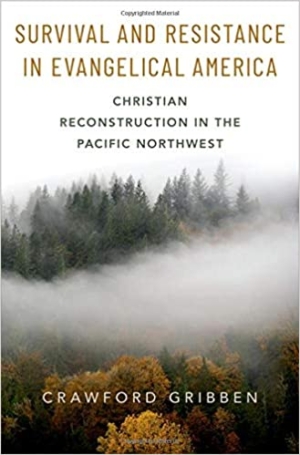
New In Print: Survival And Resistance In Evangelical America: Christian Reconstruction In The Pacific Northwest

The publisher’s blurb says: Over the last thirty years, conservative evangelicals have been moving to the Northwest of the United States, where they hope to resist the impact of secular modernity and to survive the breakdown of society that they anticipate. These . . . Continue reading →

The Myth Of The Bell Rope

Events described by the author of the Savage manuscript, in other words, provide an opportunity to reimagine Edwards as an active promoter of the most radical dimensions of the evangelical new birth experience—a figure who, during the early months of the Awakening, . . . Continue reading →

I’ve Had It With Organized Religion

Had I a nickel for every time someone has said “I’ve had it with the church” or “I’ve had it with organized religion” as they walked away from the visible church, I could retire the national debt. Walking away from the visible . . . Continue reading →

Warning Signs About The State Of Evangelical Pop Culture: The Visible, Institutional Church Matters

The evangelical world is gravely ill. The disease is not Covid-19. It is not even what you might suppose it to be. After all, we should not be surprised to find out about sin within the highest precincts of Big Eva. The . . . Continue reading →

Of QAnon, Calvin, And the LA Times

It is a deep animus that would seek to tie John Calvin (1509–1564) to the QAnon-fueled wackos who stormed the American capitol earlier this month but that is what Richard Hughes tries to do in a recent editorial in the Los Angeles . . . Continue reading →

An Appreciation Of J. I. Packer And A Dissent

On 17 July, 2020 J. I. Packer (b. 1926) went to be with our Lord. Like Carl Trueman I am thankful for Packer. As a young evangelical, Packer and John R. W. Stott saved me from the mindless evangelicalism toward which I . . . Continue reading →

Straight Out Of Münster

I think I first read about “web logs” about 1995, when I was teaching at Wheaton College. Then they were the domain of people writing about what they had for breakfast. They were daily, public journals where people recorded online their most . . . Continue reading →

Swaim: Machen Was Right

In 1923, a young assistant professor of New Testament at Princeton Theological Seminary named J. Gresham Machen published a scathing critique of the worldview animating establishment or “mainline” Protestant Christianity in Europe and America. That worldview, Machen argued in Christianity and Liberalism, . . . Continue reading →

New Film: American Gospel

For far too many American and global Christians, the “prosperity gospel” is all they know of Christianity. For far too many Christians what the Scriptures actually teach about the law and the gospel is almost entirely unknown. Their leaders and influences are . . . Continue reading →

What Kind Of A Reformation Do We Need?

One of the questions submitted to the Reformation conference last fall at the Lynden URC asks “in regards to the current state of the church, what is needed in terms of a Reformation?” That’s a great question. If we are talking about . . . Continue reading →

A Pulpit Is Not A Platform

A Pulpit Is Not A Platform Since the early 18th century, American Christianity has been dominated by personalities. George Whitefield, the Wesleys, and Jonathan Edwards feature prominently in any narrative of the history of eighteenth-century American Christianity. When we think of the . . . Continue reading →

On Memorial Day: All Christians Are Historians

In the United States, Memorial Day is day for remembering those who died in the service of the US military. It began as Decoration Day in 1868, on which day 5,000 people decorated the graves of Union and Confederate soldiers at Arlington . . . Continue reading →