III. However, the received opinion among the orthodox is that the promise given to Adam was not only of a happy life to be continued in paradise, but of a heavenly and eternal life (to which he was to be carried after . . . Continue reading →
History of Reformed Theology
Owen: Leviticus 18:5 Is Nothing But A Revival Of The Covenant Of Works
1. This covenant, called “the old covenant,” was never intended to be of itself the absolute rule and law of life and salvation unto the church, but was made with a particular design, and with respect unto particular ends. This the apostle . . . Continue reading →
Sibbes: Leviticus 18:5 Is A Covenant Of Works
Quest. Now, whence comes this rootedness and firm stability of God’s children? Ans. Especially from this, that they are now in the covenant of grace, rooted in Christ, who is God-man, in whom they are firmly rooted. In Adam we had a . . . Continue reading →
Calvin On Leviticus 18:5: A General Statement Of The Law That Offers Reward To Those Who Obey Perfectly
LEV. 18:5. Ye shall therefore keep my statutes. Although Moses introduces this passage, where he exhorts the Israelites to cultivate chastity in respect to marriage, and not to fall into the incestuous pollutions of the Gentiles, yet, as it is a remarkable . . . Continue reading →
Usher: The Covenant Of Works Is The Sum Of The Law
How hath the Moral Law been delivered since the Fall? The Sum thereof was comprised in ten Words, (Exod. 34:28; Deut. 4:13.) commonly called the Decalogue or Ten Commandments; solemnly published and engraved in Table of Stone by God himself, (Deut. 4:14 . . . Continue reading →
New In Print: Rollock’s Questions And Answers On The Covenant And Sacraments

Too often the story of the development of Reformed theology covers a few major figures in the early to mid-16th century before leapfrogging into the 17th century. With this excellent translation and these judicious selections, Aaron Denlinger has done us all a . . . Continue reading →
Office Hours: Chad Van Dixhoorn On The Westminster Assembly

If you are Reformed or on your way to becoming Reformed you have probably heard and possibly read the Westminster Confession of Faith and perhaps of the Westminster Shorter Catechism. If you’re more experienced you might even have some experience of the . . . Continue reading →
Who Are The Reformers? Philipp Melanchthon

Source
Beza On The Threefold Division Of The Law
The law of the Lord our God that was handed down to His people through Moses is partly ethical, partly sacrificial, and partly political.3 The ethical portion shows in what way each person must be disposed of both toward God most of . . . Continue reading →
Barth V. The Barthians On The Central Dogma Reading Of Calvin
Unlike many older Calvin scholars, then, I would not try to understand Calvin terms of a single thesis in the Institutes such as the glory of God, predestination, providence, or meditating on the future life, then using this as a master principle . . . Continue reading →
Coming Soon: Theodore Beza On The Lord’s Supper
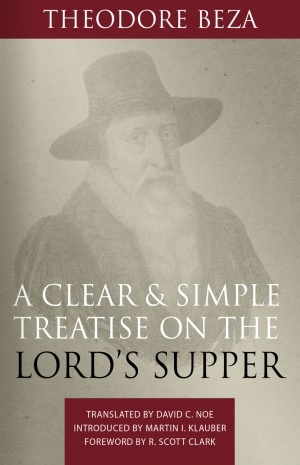
Theodore Beza lived from 1519 until 1605. This means that he was a boy when the Reformation occurred and was nearing his death as the controversy between Arminius (whom Beza taught in Geneva) and the Reformed churches was developing. In between, he . . . Continue reading →
Calvin Birthday 2016: Resources For Understanding Calvin

John Calvin was born on this date, 10 July 1509. He died in 1564. He was author of many volumes (including a massive Bible commentary, hundreds of personal letters, and public treatises), most famous of which is his Institutes of the Christian . . . Continue reading →
New In Print: Cocceius On The Doctrine Of The Covenant And Testament of God

In the history of Reformed theology, few volumes have been as important as Johannes Cocceius’ Doctrine of The Covenant and Testament of God (3rd edition, 1660). It appears in English for the first time as volume 3 in the Classic Reformed Theology . . . Continue reading →
How Reformed Orthodoxy Was Lost
J. A. Turretin’s struggle against the Consensus, in which he achieved victory in 1705, was, therefore, part of an effort for an inclusive Protestant fellowship. He did not press the issues raised in earlier discussions—predestination, imputation of original sin, the presence of . . . Continue reading →
Heidelcast 103: Recovering The Covenant Of Works (3)

The doctrine of the covenant of works was taught by the Dutch, the Germans, the French, the Swiss, the English, the Scots, and the Irish. It was taught in the 1560s (it was arguably implied in the 1561 Belgic Confession’s phrase “commandment . . . Continue reading →
Vos: Whoever Has Historical Sense Can See The Covenant Of Works In The Earlier Reformed Writers
This overview is sufficient to show how the older writings can manifest the covenant doctrine in Reformed theology. But, one might perhaps say, that only applies to the covenant of grace. These historical data cannot prove that the covenant of works belonged . . . Continue reading →
Zwingli On Sacramentarians And Infant Baptism (1529)
Others, like the sacramentarians, (those are justly called sacramentarians, who attribute to the sacraments what they do not contain, and by high-sounding but false and made-up promises, lead men away from simple trust in the one God to belief in the power . . . Continue reading →
In Praise Of (Renaissance) Humanism

In article 10 he defined the literal sense just as most traditional evangelical and Reformed interpreters would: the sense intended by the author. This is an important correction to the late-modern subjectivist move to elevate the reader and his subjective experience of the text over authorial intent. Thomas represents a broad classical and Christian consensus about how to regard authors and texts. Augustine had argued that reading a text according to the author’s intent was an act of charity, a way to love one’s neighbor as one’s self. Continue reading →
The Reformed Churches: We Distinguish But Do Not Separate The Two Natures Of Christ

Question 17. Why must he in one person be also very God? That he might, by the power of his Godhead, sustain, in his human nature, the burden of God’s wrath; and might obtain for and restore to us, righteousness and life. . . . Continue reading →
Muller On The History Of The Exegesis Of Hosea 6:7
Adam in Hosea 6:7: generic or specific? An example of a different order is the exegesis of Hosea 6:7, where the medieval tradition had rested unquestioningly on the Vulgate rendering, “ipsi autem sicut Adam transgressi sunt pactum.” The text indicated, as virtually . . . Continue reading →