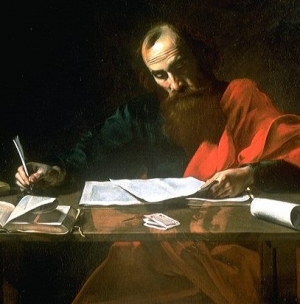
…they gloried in the mere knowledge of it: to obviate this mistake, he declares that the hearing of the law or any knowledge of it is of no such consequence, that any one should on that account lay claim to righteousness, but . . . Continue reading →
Eschatology
Romans 2:13—Justified Through Our Faithfulness? (3)
In part 2 we considered Romans 2:13 in its own context (Romans 1:18–3:20) and the impulse to distinguish between an initial stage of justification sola gratia, sola fide, on the basis of Christ’s righteousness imputed, and a final stage of justification in . . . Continue reading →
Romans 2:13—Justified Through Our Faithfulness? (2)
In part 1 we began looking at a neglected aspect of the current controversy over justification and sanctification. What has been neglected is a 1978 proposal that, at the judgment, “faithful disciples” will be justified before God through their faithfulness. The current controversy . . . Continue reading →
Romans 2:13—Justified Through Our Faithfulness?
As I mentioned in an earlier post in Romans 2:13 Paul writes, “For it is not the hearers of the law who are righteous before God, but the doers of the law who will be justified” (ESV).1 The chapter begins with matter of . . . Continue reading →
Olevianus On Romans 2:13
In 1529, one of Luther’s principal opponents, Johannes Eck (1486–1541) published the first edition his Enchiridion Against Luther and Other Enemies of the Church a refutation of the Protestant errors. Under the heading, “De fide et operibus” he proposed thesis that “faith . . . Continue reading →
Berkhof On The Standard Of Final Judgment
The standard by which saints and sinners are judged will evidently be the revealed will of God. This is not the same for all. Some have been privileged above others, and this naturally adds to their responsibility, Matt 11:21–24; Rom. 2:12–16. This . . . Continue reading →
Our Sins Won’t Be Revealed
XVII. Further, if it is asked here whether the sins of the pious equally as well as of the wicked will be revealed, we answer that the negative seems more probable to us. (1) On account of the judge, who since he . . . Continue reading →
Saturday And The Silence Of The Lamb
During this season, which many Christians call “Holy Week,” I am perversely drawn to Saturday. Perhaps it is because the Saturday between “Good” Friday and Resurrection Day is, for others a sort of relief. For them it is a day off from . . . Continue reading →
Of Blood Moons, Lunatics, and Snark
John Hagee, the controversial leader of Cornerstone Church in San Antonio (anointed by none other than W. A. Criswell) has announced that the series of lunar eclipses (tetrads) that began about 2:00 AM today, which will be repeated in October 2014, April . . . Continue reading →
The Ten Points Of Marxism
1. Abolition of property in land and application of all rents of land to public purposes. 2. A heavy progressive or graduated income tax. 3. Abolition of all right of inheritance. 4. Confiscation of the property of all emigrants and rebels. 5. . . . Continue reading →
The Utopia Of Leisure
in communist society, where nobody has one exclusive sphere of activity but each can become accomplished in any branch he wished, society regulates the general production and thus makes it possible for me to do one thing today and another tomorrow, to . . . Continue reading →
Has The Church Replaced Israel?
It is a common canard among Dispensationalists that Reformed theology must teach that the church “replaces” Israel. They call this “Replacement Theology.” That must is what is known as an a priori, something that someone “knows” before they’ve actually looked at the . . . Continue reading →
We Condemn Jewish Dreams Of A Golden Age
THE SECTS. We therefore condemn all who deny a real resurrection of the flesh (II Tim. 2:18), or who with John of Jerusalem, against whom Jerome wrote, do not have a correct view of the glorification of bodies. We also condemn those . . . Continue reading →
Baruch Maoz: Christian Zionism Is Wrong
The fawning, spineless adoration of Israel and of all things Jewish is decidedly sub-Christian; it runs against the grain of biblical revelation; it lacks the courage of its most fundamental convictions; it disenfranchises the Palestinians by assuming that the negation of their . . . Continue reading →
Justification and Vindication
One of the more disturbing aspects of the Federal Vision program is its doctrine of final justification. Let’s be clear here: Protestants have no such thing. We do not not equivocate (use the same word in two senses at the same time) . . . Continue reading →
Covenant Theology Is Not Replacement Theology
Recently I had a question asking whether “covenant theology” is so-called “replacement theology.” Those dispensational critics of Reformed covenant theology who accuse it of teaching that the New Covenant church has “replaced” Israel do not understand historic Reformed covenant theology. They are imputing . . . Continue reading →
We Are Not Polishing Brass On A Sinking Ship
More than 30 years ago, when I first came into contact with Reformed theology, piety, and practice (the Reformed confession broadly defined), I also came into contact with a movement within the Reformed world known as “Christian Reconstructionism” and its child “theonomy.” . . . Continue reading →
A Case for A-millennialism Available on Kindle
Kim Riddlebarger’s excellent book, A Case for Amillennialism is now available for Kindle. I just got my copy (to go along with the print version on my shelf). You never know when you might need to make reference via mobile device. Here’s . . . Continue reading →
The Two Witnesses and Lampstands in Revelation 11
Bill asks, [C]ould you give me a quick answer to who the two witnesses are in Rev 11:3, and the identity of the two olive trees and two lamp stands in verse 4? Dear Bill, I understand the Revelation to have been . . . Continue reading →
The Israel of God (traditional Chinese characters)
神的以色列 The Israel of God 作者:司考特»¢克拉克R. Scott Clark 歷史神學與系統神學副教授 西敏斯特加州神學院 2003 版權所有 序言 Introduction 末世論(Eschatology)這一個詞的含義遠比我們所說會在最后的日子裡將要發生的那些事來得多。我們在末世論中所說得我們要做的事都源於神在歷史裡的作為。 爭論的中心是關於«神的以色列»的問題(加拉太書 6:16)。當然,這不是一個新問題。主在世間的事工期間,以及在他復活后升天前,門徒一次次問他,«主啊,你復興以色列國,就在這時候嗎?»(使徒行傳 1:6). 事實上,一種廣為流傳的拉比式的普遍觀念是彌賽亞應該是一個強大的政治軍事人物,有著大衛般的力量和才干»”»”«大衛殺死萬萬» (撒母耳計上 18:7)。約翰福音 6:14-15 記載著, 眾人看見耶穌所行的神跡,就說:«這真是那要到世上來的先知。» 15耶穌知道群眾要來強迫他作王,就獨自又退到山上去了。 而與一些人所想的不同,建立一個地上的國度是與他到來的初衷格格不入的。而且,在他的生命的最后時刻,在他得勝的時刻,他並不是要建立一個地上的王國,而是為了實現預言。 «錫安的居民哪,不要懼怕;看哪,你的王來了,他騎著小驢來了。» (約翰福音 12:15; 以賽亞 40:9; 撒迦利亞 9:9). 耶穌教導他的門徒等人,他來並不是為了他們所盼望的國度,而是來拯救眾人脫離罪惡。最終,當以色列民眾無法再忍受他拒絕接受他們的末世論,他們對歷史的計劃,他們在十字架上釘死了他。經上說, 祭司長、經學家和長老也同樣譏笑他,說:«他救了別人,卻不能救自己。如果他是以色列的王,現在可以從十字架上下來,我們就信他。 (馬太福音 27:41-42) 令人心痛的是,很多基督徒也同意這些祭司長和經學家。傳統的時代論(Dispensationalism)長期以來認為法利賽人對聖經有著正確的解釋方法,隻是得到了錯誤的結論*1。 時代論前千禧年派(Dispensational-Premillennial)相信神對亞伯拉罕起了誓(創世紀15和17章),會給他地上的民。因此, 在時代論中,神的本意是要建立這樣的一群人。而猶太人拒絕了第一個提議(或耶穌拒絕了他們的條件!),那就一定會在千禧年時有一個地上的,猶太人的,聖地 上的國度。 根據時代論,神衷心創建這樣一個地上的民族,這是道成肉身,童女生子和耶穌在世上事工的重要原因。如果人們接受了神的這樣的提議,那麼耶穌就不會死了。在這樣的主題下,他們認為耶穌在十字架上的贖救的死隻是神對以色列民族計劃中的一種快樂的副產品。 . . . Continue reading →


