We would expect those outside the Augustinian mainstream of the Western church to object to the teaching of doctrine of predestination (i.e., the doctrines of election and reprobation) since they reject the doctrines. The reader might be surprised, however, to learn that . . . Continue reading →
Canons of Dort
The Canons Of Dort (10): Unconditional Grace Gives Assurance
The Remonstrants were convinced that the Protestant doctrine of salvation by grace alone (sola gratia), through faith alone (sola fide) did not and could not produce sufficient sanctification (holiness) and obedience. Thus, without admitting to it, they turned the covenant of grace . . . Continue reading →
Canons Of Dort (9): The God Who Elects Unconditionally Does Not Change
One of the most remarkable developments in late modern evangelical theology was the rise of the so-called doctrine of “Open Theism.” This doctrine holds that the future is genuinely unknown to God. It is “open” to him and he to it. According . . . Continue reading →
Canons Of Dort (8): There Is Only One Kind Of Election
The Remonstrants were dissatisfied with the basic insights of the Reformation and thus of the Reformed faith. They did not agree with the Protestant articulation of the gospel, that Christ came for his elect, to be their obedient, righteous substitute, to die . . . Continue reading →
Remembering The Canons Of Dort: Early Registration Ends December 1, 2018
The theme for the annual faculty conference is Remembering the Canons of Dort. The conference is scheduled for January 18–19, 2019 on the campus of Westminster Seminary California. Until December 1, 2018, the registration fee is $50.00 After the December 1, it . . . Continue reading →
Canons Of Dort (7): God Graciously Chose His Elect Out Of The Mass Of Fallen Humanity
The Synod of Dort gathered for several reasons but among them two were chief: to defend basic Augustinian anti-Pelagian theology and preserve the Protestant Reformation doctrines of salvation by grace alone (sola gratia), through faith alone (sola fide). They Reformed churches from . . . Continue reading →
Canons Of Dort (6): God Is The Cause Of Salvation But Not Of Reprobation
Perhaps the most fundamental complaint of the Remonstrants against Reformed theology, the concern that most animated Arminius’ desire to revise Reformed theology, was the charge that the Reformed view makes God the author of evil. In his desire to fix this problem . . . Continue reading →
Canons Of Dort (5): God Ordains Means To Call His Elect
The first thing that the Reformed churches said in response to the Remonstrants, whom the Reformed saw as seeking to take the churches back toward the medieval system of salvation by grace and our cooperation with grace, was, in effect, “we are too sinful to be saved by any other way than by God’s unconditional favor” (sola gratia). The second thing that the Reformed did in response to the Remonstrants was to quote two passages: 1 John 1:9 and John 3:16. Continue reading →
One Practical Benefit Of Remembering The Synod Of Dort
Eight years ago my colleague at Abounding Grace Radio, Chris Gordon, wrote some important essays calling attention to the parallels between contemporary Federal Vision movement and the Arminian movement at the Synod of Dort. He was quite right to do so. Following . . . Continue reading →
Office Hours: Remembering The Canons Of Dort With W. Robert Godfrey
What if I told you that one of the most important events in the history of Reformed theology and in the Reformed churches almost did not happen, that, indeed, theologically indifferent politicians and well connected critics of the Reformed confession almost persuaded . . . Continue reading →
Canons Of Dort (4): Unconditonal Grace
In the preface to the Canons of Dort, Synod characterized the challenges she faced and the promise on which she relied to face those challenges. The preface characterized the Christian life as a “this wretched pilgrimage.” It is one, however, that is conducted under the shepherding care of Jesus, our high priest, who has “entered the heavenly sanctuary to go to his Father,” who is fulfilling the Great Promise behind the Great Commission: “A Lo, I am with you always, even to the end of the age” (Matt 28:20). Continue reading →
Canons Of Dort (3): Synod Approaches
We live now in a “victim culture.” The best example of this is so-called “intersectionality.” This is a reference to the different ways in which one has been victimized. They intersect in the victim. It is like a game, the one with the great number of claims to victim status wins. Heather MacDonald explains: “‘Intersectionality’ refers to the increased oppression allegedly experienced by individuals who can check off several categories of victimhood—being female, black, and trans, say.” Continue reading →
The Canons Of Dort (2): The Crisis Intensifies
Because the followers of Arminius have been (mostly) ecclesiastically separated from the Reformed churches for centuries it is easy to lose sight of the fact that the Arminian crisis occurred originally within the doors of the Reformed church. Despite the grave reservations about his theology and teaching expressed by Plancius and other ministers in his Classis (Presbytery), and by his colleagues Gomarus and Trelcatius Jr, Arminius was and remained a minister in good standing in the Reformed church (Hervormde Kerk) in the Netherlands. In a way, that he conducted his minister and died within the church intensified the problem because, in the absence of any unequivocal ecclesiastical pronouncement, that fact made it possible for his apologists to say (as apologists for the Federal Vision to say today about some of their theologians, e.g., Norman Shepherd) that “he is a minister in good standing.” Continue reading →
The Canons Of Dort (1): Introduction And Background
Few of our Reformed confessional documents are as valuable and yet as neglected as the Canons of Dort. Today most who know about them think of them as the so-called and quite misleading “Five Points of Calvinism” or TULIP: Total Depravity, Unconditional Election, Limited Atonement, Irresistible Grace, and Perseverance of the Saints. Strangely, for many, especially those in the self-described Young, Restless, and Reformed movement, the “Five Points” have become the be all and end all of “Reformed theology.” The truth is that there is much more to Reformed theology than the five points. Continue reading →
Remembering The Canons
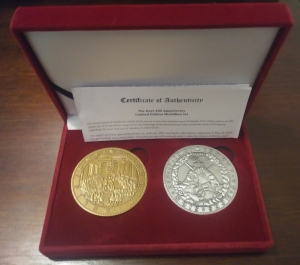
Not everything in my (surface) mailbox at work is equally fascinating but on Monday afternoon I found these sent as a gift from someone (thank you!) from The Dort Store in Otsego, MI (about 37 miles south of Grand Rapids). These are . . . Continue reading →
AGR: With Chis Gordon On The Free Offer Of The Gospel
At the international Synod of Dort (1618–19) the Reformed churches across the Netherlands, the British Isles, and Europe confessed: “As many as are called by the gospel are sincerely called. For God has most earnestly and truly declared in His Word what . . . Continue reading →
Canons Of Dort Day 2018: Their Churchly Context
The “New Calvinists” and the self-described Young, Restless, and Reformed movement has brought new interest in Reformed theology, piety, and practice. In the last 15 years Mark Driscoll and John Piper have been the gateway for many to find and join Reformed . . . Continue reading →
Resources On The Free Or Well Meant Offer Of The Gospel
The Three Points of Synod Kalamazoo (1924) Common Is Not Neutral (On The Three Points Of Synod Kalamazoo) The Synod of Dort On The Serious And Promiscuous Call Of The Gospel John Murray on the Free Offer of the Gospel Joseph H. . . . Continue reading →
The Synod Of Dort On The Sincere And Promiscuous Offer Of The Gospel
Moreover, the promise of the gospel is that whosoever believes in Christ crucified shall not perish, but have eternal life. This promise, together with the command to repent and believe, ought to be declared and published to all nations,2 and to all . . . Continue reading →
The Role of Creeds and Confessions in Doing Theology
A wise traveler makes preparations for a trip (Matt. 10:8–10). Any traveler who attempts a difficult journey without a map risks not arriving or worse. The Christian life is a journey to the heavenly city (Heb. 11:8–15). A map is a record . . . Continue reading →