
When, therefore, we saw very evidently that the chief men in the Church beyond the authority of Scripture assumed this authority so to enjoin fasts as to bind men’s consciences, we allowed consciences to be freed from these snares, but by the . . . Continue reading →
rule of worship
Sola Scriptura Protects Christian Liberty
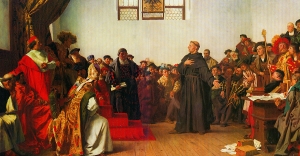
In April 1521, when Martin Luther stood before the powers of this world at the Diet of Worms, he did so on the basis of the sole, unique, and final authority of God’s Word. Luther confessed that his conscience was bound by . . . Continue reading →
With The Reformed Pubcast On Lent And Sola Scriptura

According to the western church calendar this is the Lenten season (the 40 days from “Shrove Tuesday” to Easter) and it is being more widely observed within NAPARC. This is worth noting since, historically, most Reformed churches have not observed Lent and have . . . Continue reading →
Between The Anabaptists And The Romanists: Calvin Defended Infant Baptism Sola Scriptura
I do not, however, concede to [Rome] that Paedobaptism had its origin the Tradition of the Church. It certainly appears to be founded on the institution of God, and to have derived its origin from circumcision. It would have little foundation if . . . Continue reading →
Belgic Confession: Sola Scriptura Applied To Public Worship
We believe that those Holy Scriptures fully contain the will of God, and whatsoever man ought to believe unto salvation is sufficiently taught therein. For since the whole manner of worship which God requires of us is written in them at large, . . . Continue reading →
The Church Of The Holy Elaboration

One of the highlights of the Spring semester is the opportunity to read through and discuss the Belgic Confession. Yesterday, as we worked through articles 24–27, a theme emerged. One of the great differences between the Roman communion and the Reformed communions is . . . Continue reading →
The Rule Of Worship, Christ And Culture, And Asparagus Fest

As near as I am able to determine, the first fellow in the procession is a minister in the Church of England. I infer this from his (Roman) clerical garb, from which I infer that he might also be sympathetic to the . . . Continue reading →
Owen On Sola Scriptura As Applied To Public Worship
Q. 3. How, then, are these ways and means of the worship of God made known unto us? A. In and by the written word only, which contains a full and perfect revelation of the will of God as to his whole . . . Continue reading →
If We May Pray Uninspired Words, Why May We Not Sing Them?

What the Fathers called the “rule of faith” (which included both doctrine and practice) and what Calvin called the “rule of worship” Christians in the Presbyterian and Reformed tradition have called the “regulative principle of worship” since the mid-20th century. That rule, . . . Continue reading →
If Believers Are Playing Instruments In Heaven, Why May We Not? (1)

Whenever a defense is advanced for something like the historic Reformed understanding of the rule of worship one of the objections that regularly arises is this: if musical instruments are being used in Scripture, we may we not use them now in . . . Continue reading →
If Believers Are Playing Instruments In Heaven, Why May We Not? (2)

The question before us concerns what the church ought to do in public worship. Christians often ask, “If they did x in Scripture, why may we not do them now?” In part 1 we considered the problems associated with this approach to . . . Continue reading →
With Presbycast On The Regulative Principle of Worship

It is always a joy to talk about what Scripture says and what the Reformed and Presbyterian Churches confess about worship and never more so than when it is with the redoubtable Chortles Weakly and Presbycast. His partner in crime, Wresbyterian, was . . . Continue reading →
Worship: A Dialogue Not A Checklist

Most of the debate over the so-called “worship wars” for the last 30 years has focused on the disagreement between those who favor a progressive/contemporary style of worship and those who favor a more “traditional” style of worship. One of the reasons . . . Continue reading →
Flavel Versus Cary: The Baptists Have Made Infant Baptism The Article Of Standing Or Falling Of The Church
But if your meaning be, (as I strongly suspect it is) that we must not expect to be owned by Christ, except we give up infants baptism; then, I say, it is the most uncharitable, as well as unwarrantable, and dangerous censure . . . Continue reading →
The Judgment Of A 1574 Dutch Provincial Synod On Organs And Alms
50. As to the playing of organs in the church, it is maintained that this should be completely discontinued in accordance with the teaching of Paul in 1 Corinthians 14:19. And although some of these churches still use it at the end . . . Continue reading →
Resources On Instruments In Worship

Below are gathered the quotations, posts, and essays from the Heidelblog on the history, theology, and practice of instruments in public worship. Continue reading →
Synod Of Dort (1578): Psalms Only To Be Sung In Worship
76. The Psalms of David translated by Pieter Datheen shall be sung in the Christian gatherings of the Netherlands churches as has been done until now, excluding the hymns which are not found in the Bible. National Synod of the Netherlands, German, . . . Continue reading →
1578 Synod Of Dort: Organs To Be Removed ASAP
77. We do not consider the use of organs in the churches to be good especially for the preaching (services). Therefore, we judged that ministers should labor, even though organs are tolerated for a time, that they be removed at the earliest . . . Continue reading →
In Defense Of Synod 1574
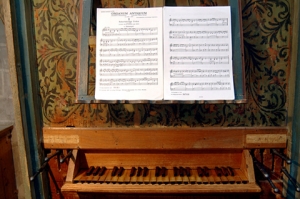
In the course of research for a couple of purposes (a journal article and a course) I have had opportunity to read the church orders and church laws of the Dutch (Reformed) churches of the 16th and 17th centuries. I have been . . . Continue reading →
William Perkins On The Rule Of Worship And 1 Corinthians 14 Contra Good Intentions
V. Will worship, when God is worshiped with a naked and bare good intention, not warranted by the word of God. (Colossians 2:23) “Which things have indeed a shew o wisdom in will worship, and humility, and neglecting of the body; not . . . Continue reading →