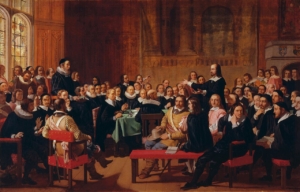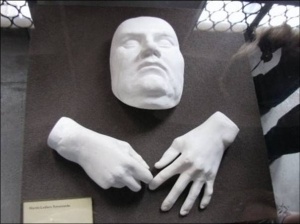
On reflection, it is rather amazing that an obscure Augustinian monk from a German backwater, teaching in an obscure school, was able to turn the Holy Roman Empire on its ear. Just as amazing is the fact that the greatest known powers . . . Continue reading →
reformation
Of Catholics, Evangelicals, and Rome
Mr. White, Mr. Black, and Mr. Gray Cornelius Van Til used to write about Mr. White (the confessionally Reformed fellow), Mr. Black (the Roman Catholic fellow), and Mr. Gray (or Grey, the Arminian fellow). His point was that, on some issues, the . . . Continue reading →
Was the Reformation a Big Misunderstanding?
The socially conservative evangelicals do not have a doctrine of a twofold kingdom; nor do they typically distinguish between nature and grace or between the sacred and the secular. Thus the only way they can cooperate with Roman Catholics on social questions is to get them converted and baptized. Continue reading →
Harry Potter And The Allure Of A Magical World
The Harry Potter movies were enchanting movies (pun intended). They are shot through with overt theological themes: ontology, good and evil, cosmology, sin, and redemption. Part way through one of them, I remembered something that Bob Godfrey once said, something that I . . . Continue reading →
Review: Still Protesting: Why the Reformation Still Matters By D. G. Hart
In 2008, Mark Noll and Carolyn Nystrom published Is the Reformation Over? An Evangelical Assessment of Contemporary Roman Catholicism.1 The book was measured in its answer, but in an interview at the time of publication, Noll said, yes, the Reformation is over. . . . Continue reading →
Video: “Our Hermit Broke Through”—The Reformation’s Defense Of Sola Fide
Last January, Dr Clark joined Dr Mike Horton, Dr Jonathan Linebaugh, Dr Andreas Stegmann, and Dr Ashley Null to celebrate the Reformation solas in a conference put on by the Wittenberg Center for Reformation Studies. Here is Dr Clark’s talk on the . . . Continue reading →
Luther On Bound Choice: Celebrating The Recovery Of The Doctrine Of Sola Gratia (Part 1)
In 1580, when the Lutherans and the Reformed met at Montbeilard, when the topic turned to predestination, Theodore Beza (1519–1605) rose, lifted his copy of Luther’s Concerning Bound Choice (De servo arbitrio), and said, “We stand with Luther.”1 The Lutheran representatives suggested . . . Continue reading →
Luther On Bound Choice: Celebrating The Recovery Of The Doctrine Of Sola Gratia (Part 2)—Erasmus Of Rotterdam
When Desiderius Erasmus (1466–1536) was born, the printing press was about fifteen years old. Paul II was Pope. Frederick III was Holy Roman Emperor. What we think of today as the Netherlands was ruled by the House of Burgundy. Luther would not . . . Continue reading →
Who Are The True Catholics? (Part 1)
There are truly important works that simply have been forgotten or unjustly ignored. One of these is William Ames’s Fresh Suit Against Human Ceremonies in defense of the Reformed theology and practice of worship. Another is William Perkins’s 1597 treatise A Reformed Catholic, subtitled Or . . . Continue reading →
Who Are The True Catholics? (Part 2)
The Problem of Sin and Free Will In A Reformed Catholic, Perkins’s first charge against Rome, which he notes is not the principal issue, is that the Roman communion has corrupted the doctrine of sin. It comes under the heading of free . . . Continue reading →
Who Are The True Catholics? (Part 3)
Law and Gospel By definition, the command to pray presupposes faith. One cannot ask anything of God unless he believes that God has made a promise. Part of the Roman problem is that they do not distinguish the law and the gospel: . . . Continue reading →
An Interesting Conversation at My Door
Recently, a Roman Catholic laywoman and a male companion (who stood behind her with his rosary, saying prayers) came to my door on behalf of St. Mary Catholic Church in Escondido. She asked if there were any Catholics in the house. I . . . Continue reading →
Does the Westminster Confession Teach Baptismal Regeneration? (Part 1)
The efficacy of baptism is not tied to that moment of time wherein it is administered; yet, notwithstanding, by the right use of this ordinance, the grace promised is not only offered, but really exhibited, and conferred, by the Holy Ghost, to . . . Continue reading →