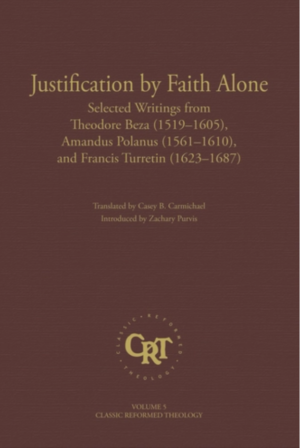
Coming In December, 2022: Beza, Polanus, And Turretin On Justification

 From its inception, the goal of the Classic Reformed Theology Series from Reformation Heritage Books (sponsor of the Heidelcast) has been to present, in English, primary source texts in Reformed theology. This new volume is the sixth in the series, which began . . . Continue reading →

Westminster’s Youngest Divine: George Gillespie

Patrick Hamilton (1504–28) was a preacher of the gospel. He studied Reformation theology in Germany and went home again to Scotland, in 1527, to preach that gospel knowing that he would die for it, and in 1528 he did. He was lured . . . Continue reading →

New In Print: Geerhardus Vos, Natural Theology

For Christians who came of age during the heyday of Barthianism, the very words “natural theology” can send shudders down the spine. Barth himself went to war against natural law, natural revelation, and natural theology of all kinds. Modern Evangelicals have resonated . . . Continue reading →

We Subscribe

The Reformation was above all a doctrinal reform in the life of the church. Throughout the Middle Ages, calls for reform had primarily been concerned with the moral life of the church. The Reformation certainly resulted in profound moral and spiritual renewal . . . Continue reading →

Inerrancy: A Historic Christian Doctrine

Now we come to the second concern of this article. Is the doctrine of the inerrancy of Scripture a fundamentalist doctrine? Clearly the doctrine of inerrancy was a doctrine held and taught in the church long before the rise of fundamentalism. Luther . . . Continue reading →

A Forgotten Catechism Recovered

One of the most forgotten Elizabethan Puritans is Richard Greenham (c. 1542–1594). As an early Elizabethan puritan, Greenham’s influence in the late 16th century was second only to that of William Perkins. He wrote a very helpful catechism on the Christian faith . . . Continue reading →

Created for Union: John Williamson Nevin And The Supper

On June 9, 1886, a funeral was held in a church in Lancaster, Pennsylvania. The deceased, John Williamson Nevin (1803–86), was a pastor, professor, and theologian in the German Reformed Church. Friends and family were in attendance as well as several theologians and professors of differing fame and reputation. None of this was unusual for a theologian’s funeral in nineteenth-century America. There was, however, at least one irregularity: A. A. Hodge (1823–16) gave one of the eulogies.1 Hodge’s late father, Charles Hodge (1797–1878), and Nevin were involved in one of the most prominent sacramental controversies in nineteenth-century America, yet the younger Hodge eulogized the very man who contested with his father decades before. Even now, the controversy and theologies that gave rise to it live on long after the death of the major figures. Continue reading →

Perkins On “The Exclusive Particle”

Throughout his works Perkins objected to the idea that one was justified by a mixed faith. On the contrary, faith was to be regarded as an instrument “to apprehend and apply that which justifies, namely, Christ and His obedience.” Perkins saw justifying . . . Continue reading →

New In Print: Petrus van Mastricht, Theoretical-Practical Theology vol. 3: The Works of God And The Fall Of Man

Petrus van Mastricht (1630–1706) was among the more important Reformed theologians of the later 17th century. According to Richard Muller, in van Mastricht we see Reformed orthodoxy and scholasticism coming to its high point technically. So students of the history of Reformed . . . Continue reading →

On Leaving The Mainline: Some Friendly Advice To The Alliance Of Reformed Churches

Kathryn Post, writing for the Religion News Service (HT: Christianity Today), writes, “On New Year’s Day, 43 congregations of the Reformed Church in America (RCA) split from the national denomination, one of the oldest Protestant bodies in the United States, in part over theological differences regarding same-sex marriage and the ordination of LGBT clergy.” This move, she says, “follows the RCA General Synod’s October decision to adopt measures for ‘grace-filled separation’ with departing churches and to appoint a team to develop a restructuring plan for those that remain.”  These 43 congregations (so far) have formed The Alliance of Reformed Churches. Continue reading →