
18Servants, be subject to your masters with all respect, not only to the good and gentle but also to the unjust. 19For this is a gracious thing, when, mindful of God, one endures sorrows while suffering unjustly. 20For what credit is it . . . Continue reading →
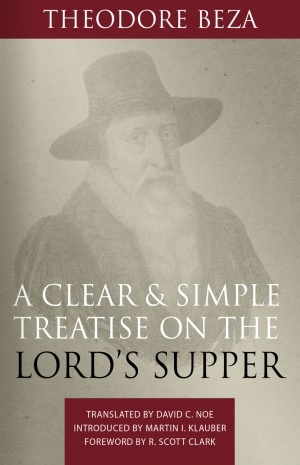
Beza On Saints’ Days, The Christian Sabbath, And Festivals
We say that it is a superstition to esteem one day more holy than another, or to think that to abstain from labour is something which, in itself, pleases God (Rom 14:5, 6; Col 2:16, 17). But, following what the Lord has . . . Continue reading →
Presbyterian And Reformed Ambivalence About Christmas
The Christmas season is nearing its climax. As the shopping ebbs and the work schedule slows a bit (for some anyway—remember in your prayers your local police and firefighters as this can be a difficult time for them) it gives us opportunity . . . Continue reading →
Taking Notes By Hand Is Better
What drives this paradoxical finding? Mueller and Oppenheimer postulate that taking notes by hand requires different types of cognitive processing than taking notes on a laptop, and these different processes have consequences for learning. Writing by hand is slower and more cumbersome . . . Continue reading →
The First Book Of Discipline (1560) On Holy Days
The word of God only, which is the New and Old Testament, shall be taught in every kirk within this realm; and all contrary doctrine to the same shall be impugned and utterly suppressed. We affirm that to be contrary doctrine to . . . Continue reading →
Good On Early Reformed Worship
The Reformed in many places closed organs, and introduced the singing of the psalms into the churches. Many of the old hymn books contained nothing but psalms, although others added hymns to the psalms. But the psalms constituted the basis and centre . . . Continue reading →
Aquinas On Islam
…those who founded sects committed to erroneous doctrines proceeded in a way that is opposite to this, The point is clear in the case of Muhammad. He seduced the people by promises of carnal pleasure to which the concupiscence of the flesh . . . Continue reading →
Calvin: Do Christians And Muslims Worship The Same God?
What A Difference Christ The Mediator Makes
For this reason I subscribe to the common saying that God is the object of faith, yet it requires qualification. Continue reading →
The Cruelty Of Nominalism
Are Symbols Arbitrary? Recently there has been considerable controversy generated in a university classroom where the prof required students to create a sign with the word “Jesus” on it and then to step on the same. One student, a Mormon, refused and was . . . Continue reading →
The John Owen Society In Oxford, UK
The John Owen Society is pleased to announce its inaugural lecture on 25th January 2016. Rev. Dr. Lee Gatiss (Director, Church Society) will speak on “The English Calvin? The Life and Legacy of John Owen.” The setting for our first event is . . . Continue reading →
Turretin On The Threefold Distinction In The Mosaic Law
I. The law given by Moses is usually distinguished into three species: moral (treating of morals or of perpetual duties towards God and our neighbor); ceremonial (of the ceremonies or rites about the sacred things to be observed under the Old Testament); . . . Continue reading →
Jesus And Allah: Do Christians And Muslims Worship The Same God?
Larycia Hawkins, an associate professor of political science, who studies and teaches courses on the intersection of religion and politics at a leading evangelical college in the USA, has created controversy in two ways: first, by wearing the Muslim hijab, as a . . . Continue reading →
The Reformed Pubcast: Vade Mecum Toward The Reformation
Les and Tanner host the popular Reformed Pubcast and they decided to put the whole enterprise at risk once again by including me in episode 103. We discussed, among other things, the definition of the adjective Reformed and the nature and role . . . Continue reading →
Office Hours: John Fesko On The Holy Spirit In The Reformed Confessions
This is season 7 of Office Hours and our theme is “The Holy Spirit: Lord and Giver of Life.” When we think of the Reformed and Presbyterian confessions we might think first of the doctrines of grace and salvation but they reflect . . . Continue reading →
Strangers And Aliens (12b): Servants Imitating The Suffering Savior (1 Peter 2:18–25)
18Servants, be subject to your masters with all respect, not only to the good and gentle but also to the unjust. 19For this is a gracious thing, when, mindful of God, one endures sorrows while suffering unjustly. 20For what credit is it . . . Continue reading →
The Necessity And Limits Of The Imitation Of Christ
There is no question among orthodox Christians, i.e., those who believe and obey God’s Word, who believe the catholic creeds, who have a substantial connection to the ancient church, whether Christians ought to seek to imitate Christ. The questions are how do we imitate . . . Continue reading →
Was Jesus A Jihadist?
In response to a post comparing the Bible to the Qur’an Gloria asks: How does one explain the passage in Mathew….”Jesus did not come to bring peace but to bring the sword…” Seems that is a “jihad” That passage in Matthew has . . . Continue reading →
A Muslim Approaches The Truth About Global Islamism And Jihad
(HT: @muddygravel) It should be added that the Ft Hood and San Bernardino attacks and others suggest that the line between ideological Islamism and violent jihad is fluid and rapidly crossed. The high percentage of Islamic Study Centers (mosques) in the USA . . . Continue reading →
They Will Help You Overcome Facts
But every word on the front page is contradicted by the facts,” I objected. Edgar gave me a tolerant smile. “You still have the mechanistic outlook, he said, and then proceeded to give me the dialectical interpretation of the facts . . . . . Continue reading →
The Bible And The Qur’an
It has been a conviction of a certain segment of scholars since at least the middle period of the German Enlightenment that all religions are essentially the same. The current twin controversies in the West (chiefly Europe and the USA) over what . . . Continue reading →


