Take away, indeed, from the heretics the wisdom which they share with the heathen, and let them support their inquiries from the Scriptures alone: they will then be unable to keep their ground. Tertullian, De res. 3. On the Resurrection of the . . . Continue reading →
Academic Stuff
Who Is anti-Science?
Using the authority of “scientific consensus” to stifle heterodox hypotheses and alternative fields of research: Science is never truly settled. Indeed, challenging seemingly incontrovertible facts and continually retesting long-accepted theories are crucial components of the scientific method. Examples of perceived truths overturned . . . Continue reading →
“Biased Facts,” Objective Reality, The Reformation, And The Resurrection
A few days ago someone, somewhere on social media, in objection to something I wrote, used the arresting expression “biased facts.” I learned from the Dutch Reformed philosophical theologian Cornelius Van Til (1895–1987) that there are no such things as uninterpreted facts . . . Continue reading →
The Greatest Creed You Have Never Read
The Symbolum Quicunque [Athanasian Creed] is a remarkably clear and precise summary of the doctrinal decisions of the first four œcumenical Councils (from A.D. 325 to A.D. 451), and the Augustinian speculations on the Trinity and the Incarnation. Its brief sentences are . . . Continue reading →
The Myth Of The Isolated Scholar
There is a myth about academic life that it is a solitary endeavor. Imagine lonely, stoic figures plodding single-file into a library to sit for hours, hidden behind walled study carrels, isolated and free from social distractions, a hushed silence strictly observed. . . . Continue reading →
“Intersectionality:” The New Secularist Religious Orthodoxy?
“Intersectionality” is the latest academic craze sweeping the American academy. On the surface, it’s a recent neo-Marxist theory that argues that social oppression does not simply apply to single categories of identity — such as race, gender, sexual orientation, class, etc. — . . . Continue reading →
Does The Nicene-Constantinopolitan Creed Require Baptismal Regeneration?
HB reader Mike asks whether this language requires Reformed believers to confess that baptism necessarily regenerates, i.e., is new life necessarily conferred at the moment of administration. It is widely claimed that “the ancient church taught baptismal regeneration.” In this context “regeneration” . . . Continue reading →
Epiphanius Of Salamis (c. 315–403): It Was Gnostics Not Christians Who Made Images Of Christ
They [the Gnostics] possess paintings—some, moreover, have images made of gold, silver and other materials—and say that such things are portraits in relief of Jesus, and made by Pontius Pilate! That is, the reliefs are portraits of the actual Jesus during his . . . Continue reading →
Hippolytus: The Heretics Make Images Of Christ
(Now these heretics) have themselves been sent forth by Satan, for the purpose of slandering before the Gentiles the divine name of the Church. (And the devil’s object is,) that men hearing, now after one fashion and now after another, the doctrines . . . Continue reading →
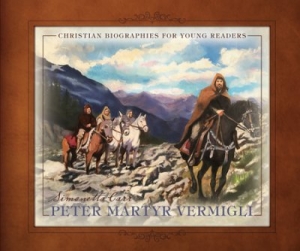
New: Peter Martyr Vermigli For Children
In our age of screens (phones, tablets, computers, watches etc) it is counter-intuitive but nonetheless true to say that books are more important than they have been for a long time. They are more important precisely because our culture is drifting away . . . Continue reading →
Preaching As For The Free
One of the privileges of editing the Classic Reformed Theology series for Reformation Heritage Books is that I get to work closely with significant Reformed texts and shepherd them through the process from translation (e.g., from Latin to English) to publication. Currently . . . Continue reading →
Students Do Better To Take Notes By Hand
When people type their notes, they have this tendency to try to take verbatim notes and write down as much of the lecture as they can,” [Pam] Mueller tells NPR’s Rachel Martin. “The students who were taking longhand notes in our studies . . . Continue reading →
Perkins On “Faith” In Hebrews 11
“Now Faith.” Faith in the word of God is specially of three sorts: historical, miraculous, [and] justifying or saving faith. First, historical faith is not only a knowledge of the word, but an assent of the heart to the truth of it. . . . Continue reading →
Machen’s Senate Testimony Against The Proposed Department Of Education (1926)
The committee met, pursuant to adjournment, at 10 o’clock am, Senator Lawrence C. Phipps presiding. Name of those present: Senators Phipps (chairman), Ferris, Copeland, and Brookhart, of the Senate Committee, and Messrs. Reed of New York, Robison, Holaday Lowrey Black of New . . . Continue reading →
Whence “The Right Side Of History”?
This idea of history having a ‘side’, which is liberal, enlightened and so on, harks back to the enlightenment of the 18th century, to the emergence of what David Hume called ‘these enlightened ages’, in sharp contrast to the side of the . . . Continue reading →
Confessional Protestantism Is Evangelical But Distinct From Evangelicalism
Both Bob and I wrote the book as catholic Christians—those who hold to the creeds of the ancient church—and as evangelical Christians—those who believe in justification by grace through faith and identify with ecclesiastical bodies which subscribe to Reformation confessions. To use . . . Continue reading →
Roger Nicole: An Open Letter to Dr. William Estep
My dear colleague, Your recent article in The Baptist Standard of Texas has come to my attention. I am grieved that you should have such a low opinion of Calvin and of Calvinistic Baptists. Although you hold that “most of the ardent . . . Continue reading →
Where Was Your Church Before Luther?
Josiah writes to the HB: Often when we think of the reformation we think back to 1517 when Martin Luther nailed the 95 Thesis on the church door in Wittenberg Germany but we describe it in such a way that it’s almost . . . Continue reading →
The Great Disappointment (October 22, 1844): A Reminder Of The Foolishness Of Ignoring Mark 13:32
William Miller (1782–1849), a lay Bible student (later a Baptist preacher), predicted that Christ would return to earth some time between 21 March 1843 and 21 March 1844. One of Miller’s followers postponed the date to 22 October 1844. When Christ did . . . Continue reading →
Polycarp Versus The Progressives
In 1973, Charles Merritt Nielsen imagined what might have happened had Polycarp (69–155 AD), the senior pastor of the Christian congregation in Smyrna (today Izmir, Turkey), adopted the rhetoric of theological progressives, who look for approval from the broader, unbelieving world: Polycarp . . . Continue reading →