The 400th anniversary of the first landing of enslaved Africans at Jamestown could have been a great and unifying moment for America. It could have reinforced the assertion of African American scholar W.E.B. DuBois that “before the Pilgrims landed we were here,” . . . Continue reading →
American History
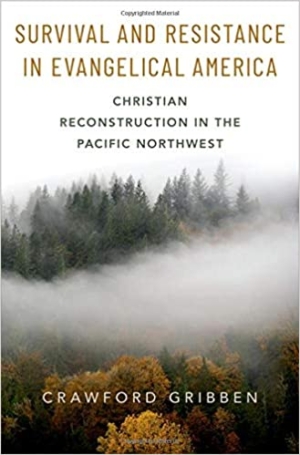
New In Print: Survival And Resistance In Evangelical America: Christian Reconstruction In The Pacific Northwest
The publisher’s blurb says: Over the last thirty years, conservative evangelicals have been moving to the Northwest of the United States, where they hope to resist the impact of secular modernity and to survive the breakdown of society that they anticipate. These . . . Continue reading →
The Myth Of The Bell Rope
Events described by the author of the Savage manuscript, in other words, provide an opportunity to reimagine Edwards as an active promoter of the most radical dimensions of the evangelical new birth experience—a figure who, during the early months of the Awakening, . . . Continue reading →
The First Great Awakening: “A Confus’d But Very Affecting Noise”
It is difficult to imagine. Jonathan Edwards countenancing the “Confus’d, but very Affecting Noise” that erupted in Suffield, Massachusetts, on July 6, 1741. Yet there he stood, his loud voice rising in prayer above the din that emanated from an assembly of . . . Continue reading →
Did Public Education Really Introduce Mass Literacy?
Most Americans were illiterate before the creation of our public education system in the 1830s. That seems to be a popular assumption, but is it true? If you’re looking for statistics, they’re notoriously hard to get when it comes to literacy rates . . . Continue reading →
Heidelcast 172: With D. G. Hart On American Catholic: The Politics Of Faith During The Cold War (Updated)
What can confessional Presbyterian and Reformed folk learn from the history of Roman Catholicism in America? Quite a lot as it turns out. We are continuing our brief hiatus from the series, As It Was In The Days of Noah to talk with . . . Continue reading →
Of QAnon, Calvin, And the LA Times
It is a deep animus that would seek to tie John Calvin (1509–1564) to the QAnon-fueled wackos who stormed the American capitol earlier this month but that is what Richard Hughes tries to do in a recent editorial in the Los Angeles . . . Continue reading →
Heidelcast 171: What American Christians Can Learn From Black History
For much of the history of North America, Christianity has been the dominant religious group and a major culture-shaping force. In the USA it, as I have noted regularly here, until quite recently people spoke of the USA as a “Christian nation” . . . Continue reading →
Angela Davis Is Not A Hero
A hardline Communist, Davis supported the Soviet invasion of Czechoslovakia in 1968 and relished being a guest of Fidel Castro in Cuba — where she went immediately following her acquittal. But her greatest love was for the Soviet Union and the Eastern . . . Continue reading →
The Strange Persistence Of Theocracy In America
It is a deeply-held conviction among more than a few American Christians that the United States was founded as a Christian nation and that it was such until relatively recently. Further, it is widely thought that if only there were a religious . . . Continue reading →
The 1619 Project Is Bad History And Boring
Thus to speak of America’s “founding” at all is necessarily to speak of what makes Americans a “people.” When Abraham Lincoln said that the nation was “conceived in liberty” four score and seven years before the dedication of Gettysburg Cemetery—that is, in . . . Continue reading →
Stephens On The 1619 Project
The 1619 Project is a thesis in search of evidence Continue reading →
National Association Of Scholars: Revoke Pulitzer Prize For 1619 Project
The Project as a whole was marred by similar faults. Prominent historians, most of them deeply sympathetic to the Project’s goal of bringing the African American experience more fully into our understanding of the American past, nevertheless felt obliged to point out, . . . Continue reading →
Another Podcast Recommendation: The Black History Fashion Show
I have been reading Lester Cahill for years and and I have been listening to his podcast since it began. Lester is one of my favorite contemporary writers and thinkers because he is independent, intelligent, passionate, and challenging. I always learn something from him. In one of his recent episodes (linked in the post) Lester critiques the recent Netflix series on Madam C. J. Walker and, in another, he introduces us to the founder of an early Black American entrepreneur. Continue reading →
Princeton Historian Rebukes 1619 Project: The Facts Still Matter
No effort to educate the public in order to advance social justice can afford to dispense with a respect for basic facts. In the long and continuing battle against oppression of every kind, an insistence on plain and accurate facts has been . . . Continue reading →
Oxford Historian Carwardine: 1619 Project “Preposterous” And “Tendentious”
As well as the essay I have read your interviews with James McPherson and James Oakes. I share their sense that, putting it politely, this is a tendentious and partial reading of American history. I understand where this Project is coming from, . . . Continue reading →
Guelzo: “The 1619 Project Is Not History; It Is Ignorance“
So, let us speak of slavery. The American republic inherited slavery from the British empire, in much the same way that it inherited its fiscal poverty, its lack of manufacturing capability, and its primitive infrastructure. We expected to overcome all of these . . . Continue reading →