Sometimes “Nazis” Really Are Nazis

In the modern culture wars (Kulturkampf) the accusation is frequently made that one side or the other is guilty of “Nazi tractics” or “Nazi ideology.” This charge is made with such frequency that it is bound to lose its force. One reaction . . . Continue reading →
Thirty Million

. . . By the estimation of leading religious demographers, over thirty million Christians perished under atheist regimes in the twentieth century. Tell this to friends who might insouciantly associate “secularism” with deliverance from religious violence. Tell this, too, to American history . . . Continue reading →

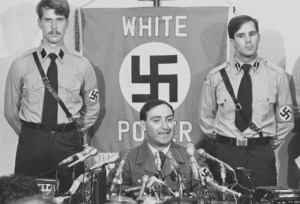
These Are Not Illinois Nazis

At Synod Calgary, held June 8–11 by the United Reformed Churches in North America (URCNA),1 as delegates debated whether or how to adopt a statement that had been adopted by several other sister churches, one pastor rose to say that three families . . . Continue reading →

Carl F. H. Henry Against The Nazis

What is widely overlooked today is that a worldview based on naturalistic evolution can provide no reasonable foundation for either the universality or the permanence of human rights; it was precisely such naturalistic theory that underlay the Nazi repudiation of the inherited . . . Continue reading →

The Confessing Church Opposed National Socialism

The Confessing Church (Bekennende Kirche) constitutes a movement (from September 1933 onward) mainly within the German Protestant Church, whose very existence helped discredit the doctrinally liberal, extremely nationalistic, and racist anti-Semitic efforts of the “German Christians” (with roots in Prussia and Thuringia) . . . Continue reading →

We Would Have Done It Too

On September 27, 1933, the national synod of the German Evangelical Church met in Wittenberg, Germany. A parade of clerics in dark robes processed along the town’s main street, passing the Stadtkirche where Martin Luther used to preach. The metal crosses hanging . . . Continue reading →