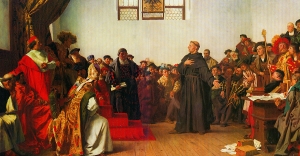
Article XI Concerning Things Commanded and Not Commanded Of self law (Autonomia) or power in the conscience, Relinquished to Christ alone in the church We confess that no one ought to command in any manner that which Christ has not commanded; also, . . . Continue reading →
Author: R. Scott Clark
R.Scott Clark is the President of the Heidelberg Reformation Association, the author and editor of, and contributor to several books and the author of many articles. He is professor emeritus of church history and historical theology at Westminster Seminary California, where he taught for 29 years. He also taught at Wheaton College, Reformed Theological Seminary, and Concordia University. He has hosted the Heidelblog since 2007 and the Heidelcast since 2009.
The Westminster Divines On Holy Days
THERE is no day commanded in scripture to be kept holy under the gospel but the Lord’s day, which is the Christian Sabbath. Festival days, vulgarly called Holy-days, having no warrant in the word of God, are not to be continued. Nevertheless, . . . Continue reading →
The Disciples Confessed Christ’s Resurrection Because It Was Objectively True
…The belief of the disciples in the resurrection, according to the New Testament, was due simply to the fact of the resurrection. Those disciples came to believe that Jesus had risen from the dead for the simple reason that Jesus had risen . . . Continue reading →
“Relevance” Leads Back To Rome
In the Western church calendar Lent began yesterday on “Ash Wednesday.” Lent did not exist in any form in church law until 325 where the word appears in Canon 5 of the canons of Nicea. Even then there is no detailed prescription . . . Continue reading →
The Gospel For Discontent Millennials (And Everyone Else)
HB reader David wrote to ask about a social program in which his congregation is involved and his question is one that I get regularly. My reading and experience with Millennials, i.e., those born between 1982 and 2004, tells me that there . . . Continue reading →
Epiphanius Of Salamis (c. 315–403): It Was Gnostics Not Christians Who Made Images Of Christ
They [the Gnostics] possess paintings—some, moreover, have images made of gold, silver and other materials—and say that such things are portraits in relief of Jesus, and made by Pontius Pilate! That is, the reliefs are portraits of the actual Jesus during his . . . Continue reading →
Machen On The Deity Of Christ
The Christian meaning of the term “deity of Christ” is fairly clear. The Christian believes that there is a personal God, Creator and Ruler of the universe, the God who is infinite, eternal, and unchangeable. So when the Christian says that Jesus . . . Continue reading →
Hippolytus: The Heretics Make Images Of Christ
(Now these heretics) have themselves been sent forth by Satan, for the purpose of slandering before the Gentiles the divine name of the Church. (And the devil’s object is,) that men hearing, now after one fashion and now after another, the doctrines . . . Continue reading →
Relics Remain
It is a general, if unstated, assumption among moderns that whatever the causes of the Reformation might have been, they must be long past. Often, however, that assumption is ill-founded. In fact, the fundamental causes for the Reformation (e.g., the Roman denial . . . Continue reading →
Why Is Anyone Still Talking About The Federal Vision?
Thomas Manton On Law And Gospel
A godly person observed that Christians are usually to blame for three things: 1) they seek in themselves what they can only find in Christ; 2) they seek in the law what will only be found in the gospel; and 3) they . . . Continue reading →
Gillespie On The Twofold Kingdom
One Instance more of his mis-alledging and perverting of testimonies. In the close he cites a passage of Mr. Case his Sermon August 22. 1645. “He (Christ) is King of Nations and King of Saints. As King of Nations he has a . . . Continue reading →
Turretin Contra Two-Stage Justification
VIII. Although our justification will be fully declared on the last day (our good works also being brought forward as the sign and proof its truth, Mt. 25:34–40), still falsely would anyone maintain from this a twofold gospel justification—one from faith in . . . Continue reading →
New: Peter Martyr Vermigli For Children
In our age of screens (phones, tablets, computers, watches etc) it is counter-intuitive but nonetheless true to say that books are more important than they have been for a long time. They are more important precisely because our culture is drifting away . . . Continue reading →
Turretin: Justification Is The “Principal Rampart” Of The Christian Religion
I. As in the chain of salvation justification follows calling (Rom. 8:30) and is everywhere set forth as the primary effect of faith, the topic concerning calling and faith begets the topic concerning justification. This must be handled with the greater care . . . Continue reading →
Office Hours With Dr Vincent Bacote: Facing Race
The problem of race in America is more deeply embedded and intractable than most American Christians probably realize. Everyone reads Scripture in a context, in a culture and that reality influences the way we understand and apply it. Race, slavery, Jim Crow, . . . Continue reading →
The QIRE Distilled To Its Essence
The Normalization Of Pedophilia Approaches
The arguments made by Milo Yiannouplos (in a recently released and quite graphic video), that pedophilia is not what you think it is, that sexual contact between men and under-age teen-age boys is not wrong but a safe way to help young . . . Continue reading →
With No Compromise Radio On Law And Gospel
It’s always a genuine pleasure to talk to Mike Abendroth on No Compromise Radio. Mike is pastor of Bethlehem Bible Church in West Boyleston, MA, where he has served for 20 years. His latest book is Evangelical White Lies. His brother, Pat, . . . Continue reading →
Forty Three Years Of Federal Vision Theology
On this date in 1546 Martin Luther completed his Christian pilgrimage on this earth. This year we are celebrating the 500th anniversary of the Reformation (October 31, 1517). It’s appropriate then, that confessional Protestants do in our time what Luther did in . . . Continue reading →