Created for Union: John Williamson Nevin And The Supper

On June 9, 1886, a funeral was held in a church in Lancaster, Pennsylvania. The deceased, John Williamson Nevin (1803–86), was a pastor, professor, and theologian in the German Reformed Church. Friends and family were in attendance as well as several theologians and professors of differing fame and reputation. None of this was unusual for a theologian’s funeral in nineteenth-century America. There was, however, at least one irregularity: A. A. Hodge (1823–16) gave one of the eulogies.1 Hodge’s late father, Charles Hodge (1797–1878), and Nevin were involved in one of the most prominent sacramental controversies in nineteenth-century America, yet the younger Hodge eulogized the very man who contested with his father decades before. Even now, the controversy and theologies that gave rise to it live on long after the death of the major figures. Continue reading →

Eating Christ: What, Why, And How (John 6:53–56)

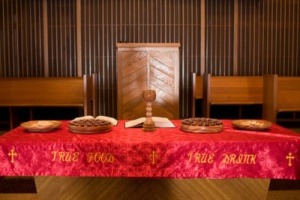
So Jesus said to them, “Truly, truly, I say to you, unless you eat the flesh of the Son of Man and drink his blood, you have no life in you. Whoever feeds on my flesh and drinks my blood has eternal life, and I will raise him up on the last day. For my flesh is true food, and my blood is true drink. Whoever feeds on my flesh and drinks my blood abides in me, and I in him (John 6:53–56; ESV). Continue reading →

Herman Witsius Contra Intinction

XXV. Next follow the actions of the disciples, and consequently of the other guests. And these, according to Christ’s appointment, are three: first, to receive both the bread and the cup; but each separately, for so Christ distributed them: in this manner . . . Continue reading →

Ignatius Of Antioch As A Remedy For Two Weaknesses In Contemporary Evangelicalism: The Reality Of Christ’s Humanity And The Reality Of The Church

Each autumn term one of my responsibilities is to spend about half the semester helping a group of students to walk through the Apostolic Fathers, a collection of second-century Christian texts which was first compiled in the 17th century. That collection has . . . Continue reading →

Virtual Communion Is Not Communion

There are several reasons why the meal that was in Jesus’ presence which he constituted as the Lord’s Supper cannot be shared across the internet’s bandwidth. First, this Supper is a churchly meal. The Supper that we receive has to be “this . . . Continue reading →