Longtime readers of this space will know that I am a flying enthusiast. Climbing into a cockpit and flying a plane is something wonderful. I have been in a couple of small planes beginning in Shafter, CA in 1986 and again flying . . . Continue reading →
Christian Life
What Passion City Gets Right And Wrong About The Sabbath
The last time we saw Atlanta Pastor Louie Giglio it was January 2013 and he was embroiled in controversy because he had been invited by President Obama to participate in his second inauguration. It had been discovered that Giglio held the biblical . . . Continue reading →
Rosaria Butterfield’s Alternative To Revoice
RESOURCES Audio Only of This Talk (Presbycast) Gay Christians? Rosaria Butterfield: Secret Thoughts of an Unlikely Convert What The New Testament Says About SSA and More Gagnon On Revoice
Summer Vacation 2018
Of Calvin, Social Justice, And The Theology Of The Cross
Yesterday (August 13) was the 477th anniversary of a small but symbolic event in Reformation history. On that date in 1541 John Calvin returned to Geneva from Strasbourg, where he had been a happy exile for about three years. On his first . . . Continue reading →
With Bill Feltner On Distinguishing The Jerusalem From Above From The Jerusalem That Is Below
There is much consternation and joy about the announcement that the United States intends to recognize Jerusalem as the capital of Israel. Some evangelicals and fundamentalists, perhaps inspired by a Dispensational understanding of redemptive history and their pre-millennial hermeneutic, are overjoyed with . . . Continue reading →
Ranchita
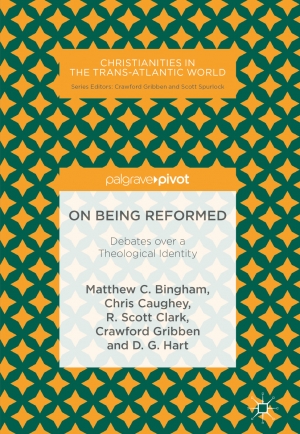
Pre-Order Now—On Being Reformed: Debates Over A Theological Identity
On Being Reformed marshals the exceptional historical and ecclesiastical expertise of its various contributors to address the much debated identity of the Reformed tradition. Informed in their use of sources, forthright in their arguments, and irenic in tone, these essays will serve readers well by helping them discern where the fault lines between Baptist and Reformed churches truly lie and also where the bonds of unity in faith and practice may be found. Both are necessary services for those of us who inhabit a living Reformed tradition and wish to see it flourish in days ahead.”
Scott R. Swain, James Woodrow Hassell Professor of Systematic Theology, Reformed Theological Seminary, USA. Continue reading →

With Janet Mefferd On What Scripture Says About Private Property
The eighth and tenth commandments, “You shall not steal” (Ex 20:15) and “You shall not covet” (Ex 20:17) are basic to biblical ethics. They are part of the natural law that God revealed to Adam in the garden, known by image bearers . . . Continue reading →
A Perfect Church? Not In This Life
In a recent book, church growth guru George Barna seems to suggest the end or irrelevance of the local congregation.1 He speaks for a significant number of people who find their congregation unsatisfying or who cannot find a church at all. It . . . Continue reading →
Office Hours: Journeys With Jesus
Millions of Christians gather every week to hear sermons preached, we trust, from God’s Word. Believers read and study it. Pastors and elders study it but we do not always agree about how to understand it. How often have you heard someone . . . Continue reading →
On Congregational Elections
A HB reader writes to ask about to think about and vote in a congregational election for elders when one does not know the nominees. This is a difficult question for a couple of reasons. First, we have little to no evidence . . . Continue reading →
Jesus: Baptism Is Death
In Luke 12:50, as part of a wide-ranging discourse with strong eschatological overtones, our Lord Jesus characterizes his coming death in a striking way. He said, “But I have a baptism with which to be baptized and how I constrained until it . . . Continue reading →
What Do We Mean By Sacrament, Sign, And Seal?
The Reformed churches and Reformed theologians (i.e., those who confess and teach within the bounds of the Reformed confessions, e.g., the French Confession (1559), the Scots Confession (1560), the Belgic Confession (1561), the Heidelberg Catechism (1563), the Second Helvetic Confession (1566), the . . . Continue reading →
Paul: Let Him Not Eat
Paul was a theologian of the twofold kingdom. In what Calvin called the “spiritual” aspect of the kingdom we find a covenant of grace in which sinners are accepted (justified) and saved by God out of his free favor (sola gratia), through . . . Continue reading →
Born Of A Woman: Against The Star Trek Christology
Recently a well-known Presbyterian minister posted a short sentence on a social media site that caused some controversy. My intent here is not to comment directly on his language but to notice and respond to some of the reaction because it illustrates . . . Continue reading →
Office Hours: Reading Scripture Canonically With Darian Lockett
The word “canon” means rule. We who confess the Reformed theology, piety, and practice confess that the holy Scriptures are the canon, the final and ruling authority for the Christian faith and life. In Belgic Confession art. 7 we confess, “We believe . . . Continue reading →
What Creepy Clowns Tell Us About Social Anxiety
The creepy clown craze caught me off guard. I suppose my earliest exposure to clowns came through the children’s television show Captain Kangaroo, hosted by Bob Keeshan. He himself had played Clarabelle the Clown on the Howdy Doody television program, which was . . . Continue reading →
The Church: The Christ-Confessing Covenant Community
When one talks about the church what is at stake is the way in which the Christian life is organized. I believe that the Bible teaches us that believers should be united to the visible community of the redeemed meeting for worship, instruction, and fellowship in an organized, disciplined, way. If I am wrong, then millions of dollars and millions of hours and lives are being sadly misspent. Continue reading →
Another Canary In Another Educational Coal Mine?
The crest of Duke University, one of the more prestigious universities in the United States, says, “eruditio et religio” (learning and piety). The crest signifies the school’s roots in the early and mid-19th century first as a joint Quaker/Methodist project and later . . . Continue reading →