
To the nomist, any anti-nomist seems antinomian Continue reading
Christian Life
Peace And Purity Provided By Authority: John Thomson’s Defense Of Presbyterian Church Polity (Part 13): The Adopting Act

As detailed in the first chapter, controversy over interpretations of what took place at the Adopting Act of 1729 abound. Thomson interpreted the events to support a strict form of subscription. He suspected that only the first half of the Adopting Act, . . . Continue reading →
New In Print: Gospel Assurance: A 31 Day Guide to Assurance
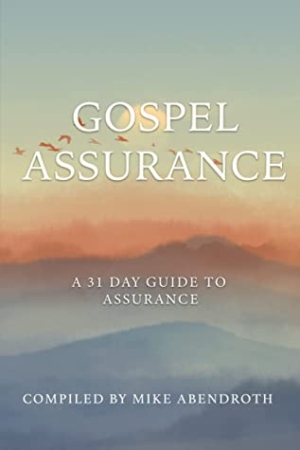
Christians often ask great questions about the doctrine of assurance of salvation: What is assurance of salvation? Do you know that you are going to heaven when you die? Is Assurance possible in this life? Can a Christian temporarily lose their . . . Continue reading →
Peace And Purity Provided By Authority: John Thomson’s Defense Of Presbyterian Church Polity (Part 12): Confessional Subscription And Doctrinal Purity
Prior to the Adopting Act of 1729, the church had only a general understanding assumed between presbyteries and individual ministers that the Westminster Standards were to be upheld. As a ‘particular’ church united together, they were not under the authority of or . . . Continue reading →
An Update On Ventura Reformed Church

But it displeased Jonah exceedingly, and he was angry. And he prayed to the LORD and said, “O LORD, is not this what I said when I was yet in my country? That is why I made haste to flee to Tarshish; for . . . Continue reading →
Peace And Purity Provided By Authority: John Thomson’s Defense Of Presbyterian Church Polity (Part 11): Obedience To Lawful Matters
Thomson distinguished between what was considered sinful and what was considered lawful. If something was considered indifferent or a matter of Christian liberty in Scripture, meaning not sinful, then the officers of the church could determine whether such an action would be . . . Continue reading →
A Word About R2K

Since David VanDrunen published, in 2010, the first volume in what has become a series of important volumes, Natural Law and the Two Kingdoms: A Study in the Development of Reformed Social Thought, Emory University Studies in Law and Religion (Grand Rapids: Eerdmans, 2010), there has been a certain degree of controversy in some quarters of the confessional Reformed world over the recovery of the “two kingdoms” as a way of thinking about Christ and culture and ethics. Continue reading →
Stemming Another Rising Tide Of Theonomy: Hebrews 7:11–14 (2)

Now if perfection had been attainable through the Levitical priesthood (for under it the people received the law), what further need would there have been for another priest to arise after the order of Melchizedek, rather than one named after the order . . . Continue reading →
New Podcast: Kids Talk Church History

Simonetta Carr sent this to us to share with you. Kids Talk Church History is a new podcast from our friends at the Alliance of Confessing Evangelicals. It is hosted by kids of various ages. This episode focuses on the persecution of . . . Continue reading →
Peace And Purity Provided By Authority: John Thomson’s Defense Of Presbyterian Church Polity (Part 10): The Peace Of The Church In Submission
Thomson, while asserting Synod’s authority to make binding acts upon lower judicatories, argued that there were appropriate times for disobedience. The primary concern of the Presbytery of New Brunswick regarding the submission to Synod was that it could potentially result in submission . . . Continue reading →
Audio: Suffering And Temptation (James 1:12–15)

Blessed is the man who remains steadfast under trial, for when he has stood the test he will receive the crown of life, which God has promised to those who love him. Let no one say when he is tempted, “I am being tempted by God,” for God cannot be tempted with evil, and he himself tempts no one. But each person is tempted when he is lured and enticed by his own desire. Then desire when it has conceived gives birth to sin, and sin when it is fully grown brings forth death (ESV). Continue reading →
Godfrey Recaps His Christendom Series
Dr. W Robert Godfrey recaps his Sunday school series on “Christendom & the Struggles with Sex, Race, Politics, & Power” with Pastor Chris Gordon on Abounding Grace Radio, addressing the disorientation Americans feel about the state of society and culture and the . . . Continue reading →
Peace And Purity Provided By Authority: John Thomson’s Defense Of Presbyterian Church Polity (Part 9): The Peace Of The Church In Submission
The Apology, in addition to questioning the extent and nature of the authority exercised by church judicatories, also questioned the authority of Synod over presbyteries. The disagreement that precipitated their objection was whether Synod had the jurisdiction to regulate the examination of . . . Continue reading →
1689 Vs. The Westminster Confession (9): Of Free Will

Our comparison and contrast of the WCF with the 2LC continues through chapter 9, “Of Free Will.” A word of explanation about this language is in order. In 2022, when we hear or read the phrase “free will,” we might be tempted to . . . Continue reading →
Paul’s Golgothic Doctrine of Sanctification

Was there a more un-sanctified and immature congregation of which we have an apostolic record than the Corinthian congregation? From a reading of Paul’s two canonical letters to them they were beset by power struggles and schisms within, tolerant of gross immorality, . . . Continue reading →
Peace And Purity Provided By Authority: John Thomson’s Defense Of Presbyterian Church Polity (Part 7): Ministerial Authority
The Presbytery of New Brunswick’s Apology in 1739 addressed two proposals made to Synod the previous year. While these acts had limited itinerant preaching and required the examination of candidates for ministry by a committee of Synod, the Presbytery of New Brunswick disregarded these acts . . . Continue reading →
From Baptist to Presbyterian: Reflections on Polity and Pastoral Ministry

In 2020, Dr. Clark interviewed me about my unconventional route to becoming a Presbyterian pastor and how I ended up receiving a call to the congregation I serve. It is strange to consider how much change can take place in only a . . . Continue reading →
1689 Vs. The Westminster Confession (8): Of Christ The Mediator
Our comparison and contrast of the WCF with the 2LC continues through chapter 8, “Of Christ the Mediator.” WCF 8.1 2LC 8.1 1. It pleased God, in His eternal purpose, to choose and ordain the Lord Jesus, His only begotten Son, to be . . . Continue reading →
What’s Going on Right Now? Sex, Race, Politics, & Power w/ Dr. W. Robert Godfrey (15)
Continuing his series, Dr. Godfrey analyzes in this episode the different options that Christians have for addressing the crumbling of Christendom. Aiming to identify a clear and helpful way forward for Christians and building on the series’ review of Abraham Kuyper’s ideologies, . . . Continue reading →
Examining Fasting, Joy, and The Christian Life
Now that Christ has come and has appeared among us—and especially now that he has completed his work of redemption—the occasion for fasting fades before us in light of our identity as a people who rejoice; for we are Christ’s bride, being . . . Continue reading →