

From 1964 until about 1973 the Ford Mustang was one of the coolest (as we used to say) cars on the road. It was instantly recognizable. The classic years were arguably 1967 or 1968. In those years the Mustang had grown up . . . Continue reading →

From 1964 until about 1973 the Ford Mustang was one of the coolest (as we used to say) cars on the road. It was instantly recognizable. The classic years were arguably 1967 or 1968. In those years the Mustang had grown up . . . Continue reading →

RESOURCES Audio Only of This Talk (Presbycast) Gay Christians? Rosaria Butterfield: Secret Thoughts of an Unlikely Convert What The New Testament Says About SSA and More Gagnon On Revoice
The second of my “Seven Concerns” about Revoice and the Spiritual Friendship movement is their unwise adoption of ungodly terminology: The adoption of terminology for self-identity that cannot be sanctified and inevitably brings in the whole “LGBTQ” baggage (“sexual minority,” “gay,” “transgender”). . . . Continue reading →
These Sections teach the following propositions: 1st. God alone is Lord of the human conscience, which is responsible only to his authority. 2d. God has authoritatively addressed the human conscience only in his law, the only perfect revelation of which in this . . . Continue reading →

When I entered the evangelical world in the mid-70s there was much talk and teaching (and guilt manipulation) about personal evangelism but not much talk of church growth. A decade later, however, when I went to seminary, it was all the rage. . . . Continue reading →
You don’t get to choose which parts of the First Amendment you like. Using the state to put someone out of business because they don’t share your beliefs is not what we do in America. A state powerful enough to tell bakers . . . Continue reading →

Yesterday (August 13) was the 477th anniversary of a small but symbolic event in Reformation history. On that date in 1541 John Calvin returned to Geneva from Strasbourg, where he had been a happy exile for about three years. On his first . . . Continue reading →
Dr. Machen was right when he stated of the liberals: “By the equivocal use of traditional phrases, by the representation of differences of opinion as though they were only differences about the interpretation of the Bible, entrance into the Church was secured . . . Continue reading →

At the Diet of Worms (April, 1518) Luther famously said, “Popes and councils do err.” Anyone who knows just a little about the history of the church must agree with Luther. Popes and councils have directly and repeatedly contradicted themselves and each . . . Continue reading →
Much of recent American Reformed theology has been caught up for some time in a distorted form of biblicism that has fallen into the trap of trying to reinvent theological wheel in areas where doing so is fraught with danger—in particular, the . . . Continue reading →

There is much consternation and joy about the announcement that the United States intends to recognize Jerusalem as the capital of Israel. Some evangelicals and fundamentalists, perhaps inspired by a Dispensational understanding of redemptive history and their pre-millennial hermeneutic, are overjoyed with . . . Continue reading →
We must maintain that we who repent and believe stand in robes of righteousness as beloved sons and daughters of God, even as we do daily battle with any an all sexual lust and unbiblical desire that claims our affections. We are . . . Continue reading →
But the preachability of a doctrine is determined by its truth, not vice versa, a point made forcefully by Luther in his response to Erasmus. It is also exemplified in the negative by the history of doctrine where the abandonment of the . . . Continue reading →

Les Lanphere is the filmmaker who gave us CALVINIST. Les and Tanner host the Reformed Pubcast. He is working on a new film on a most important topic: worship. Continue reading →
Put simply, it’s one thing to openly confess same-sex attraction, another to claim one is a ‘Gay Christian’. One would never identify as a ‘Fornicating Christian’ or a ‘Murdering Christian’, etc. Paul in 1 Corinthians 6 actually points to a new identity . . . Continue reading →

6. We have seen that Abraham, on the account of his faith, and not of his separation according to the flesh, was the father of all that believe, and heir of the world. And in the covenant made with him, as to . . . Continue reading →
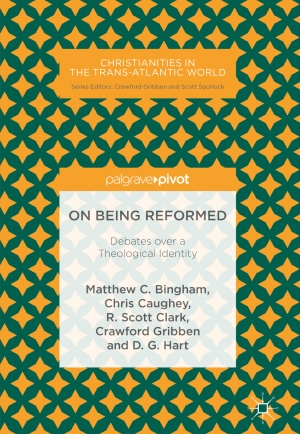
On Being Reformed marshals the exceptional historical and ecclesiastical expertise of its various contributors to address the much debated identity of the Reformed tradition. Informed in their use of sources, forthright in their arguments, and irenic in tone, these essays will serve readers well by helping them discern where the fault lines between Baptist and Reformed churches truly lie and also where the bonds of unity in faith and practice may be found. Both are necessary services for those of us who inhabit a living Reformed tradition and wish to see it flourish in days ahead.”
Scott R. Swain, James Woodrow Hassell Professor of Systematic Theology, Reformed Theological Seminary, USA. Continue reading →

Editor’s Preface During the controversy at Westminster Seminary (Philadelphia), not only did faculty devote meetings to the highly objectionable views of Norman Shepherd, but they also wrote articles for the seminary’s theological journal and even used class lectures to counter arguments from . . . Continue reading →
