
And herein is a solemn prefiguration of the implanting of believers of all nations into the covenant and faith of Abraham; for this name he received upon the solemn establishment of the covenant with him, as the apostle explains the place, Rom. . . . Continue reading →
Reformed Theology
New In Print: J. H. Heidegger’s Concise Marrow Of Theology
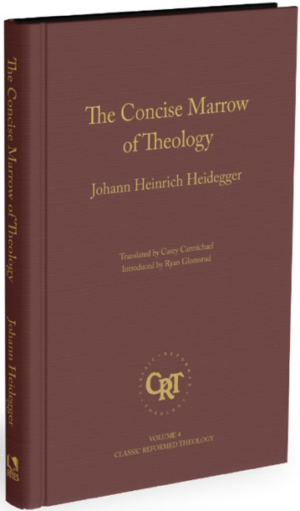
J. H. Heidegger (1633–98) was a significant Swiss Reformed theologian, in Zürich, at the end of the 17th century. This volume is a clear, accessible introduction to Reformed theology. It is not technical. It was meant to be a starting point and . . . Continue reading →
New In English And In Print: Heidegger’s Marrow Of Theology

J. H. Heidegger (1633–98) was a significant Swiss Reformed theologian, in Zürich, at the end of the 17th century. This volume is a clear, accessible introduction to Reformed theology. It is not technical. It was meant to be a starting point and . . . Continue reading →
Recovering Our Reformed Past: On J. H. Heidegger With Ryan Glomsrud (Part 2)

What if I told you that there is an entire library of orthodox, careful, influential, important, Reformed books, that formed and shaped our entire history—books on Reformed theology, piety, and practice, biblical interpretation, biblical theology, covenant theology, commentaries on Scripture, the Christian . . . Continue reading →
Recovering Our Reformed Past: On J. H. Heidegger With Ryan Glomsrud

What if I told you that there is an entire library of orthodox, careful, influential, important, Reformed books, that formed and shaped our entire history—books on Reformed theology, piety, and practice, biblical interpretation, biblical theology, covenant theology, commentaries on Scripture, the Christian . . . Continue reading →
Office Hours With Ligon Duncan On Covenant Theology and More
Dr J. Ligon Duncan III is Chancellor and CEO of Reformed Theological Seminary, where he is also the John E Richard Professor of Systematic and Historical Theology. He was senior pastor of First Presbyterian Church (PCA) in Jackson, Mississippi for 17 years . . . Continue reading →
John Owen Was Not A Baptist (Part 2)
Obs. I. Believers under the new testament have lost nothing, no privilege that was enjoyed by them under the old. Many things they have gained, and those of unspeakable excellency, but they have lost nothing at all. Whatever they had of privilege . . . Continue reading →
Canons Of Dort (3): Synod Approaches

We live now in a “victim culture.” The best example of this is so-called “intersectionality.” This is a reference to the different ways in which one has been victimized. They intersect in the victim. It is like a game, the one with the great number of claims to victim status wins. Heather MacDonald explains: “‘Intersectionality’ refers to the increased oppression allegedly experienced by individuals who can check off several categories of victimhood—being female, black, and trans, say.” Continue reading →
The Canons Of Dort (1): Introduction And Background
Few of our Reformed confessional documents are as valuable and yet as neglected as the Canons of Dort. Today most who know about them think of them as the so-called and quite misleading “Five Points of Calvinism” or TULIP: Total Depravity, Unconditional Election, Limited Atonement, Irresistible Grace, and Perseverance of the Saints. Strangely, for many, especially those in the self-described Young, Restless, and Reformed movement, the “Five Points” have become the be all and end all of “Reformed theology.” The truth is that there is much more to Reformed theology than the five points. Continue reading →
Engaging With 1689

Recently I had opportunity to engage in a friendly dialogue with some Baptist academics over the merits of the project proposed in Recovering the Reformed Confession. That project is, as they say, wending through the publication process. Because of space limitations I was unable to do a couple of things, namely, to engage more fully with some of the texts and approaches to Baptist covenant theology (as distinct from Reformed covenant theology). Continue reading →
William Perkins: Who Are The True Catholics?

There are truly important works that have simply been forgotten or unjustly ignored. One of those is William Ames’ Fresh Suit Against Human Ceremonies in defense of the Reformed theology and practice of worship. Another is William Perkins’ 1597 treatise, A Reformed . . . Continue reading →
Office Hours: Introducing Johannes Cocceius On Covenant Theology In English
For most of his long career, Johannes Cocceius (1603–69) taught Old Testament, biblical theology, theology, and philology in the Netherlands. He was arguably one of the most important and influential Reformed theologians of the 17th century and his influence continues to be . . . Continue reading →
A New Online Resource For Bible Study

Travis Fentiman wrote to let me know about a resource site he has compiled which is built on Spurgeon’s recommended list of commentaries and upon resources such as the Post-Reformation Digital Library (PRDL). It is a gateway to older, online biblical commentaries. . . . Continue reading →
Which Classic Reformed Works To Read In English?

Rob writes, Listening to you on the Heidelblog/Heidelcast and Office Hours, you have given me a enormous desire to read more “classic reformed theology.” I am currently reading Turretin’s Institutes and I would love to know who are some more classic reformed . . . Continue reading →
Who Are The Reformers? Caspar Olevianus

New In Print: Rollock’s Questions And Answers On The Covenant And Sacraments

Too often the story of the development of Reformed theology covers a few major figures in the early to mid-16th century before leapfrogging into the 17th century. With this excellent translation and these judicious selections, Aaron Denlinger has done us all a . . . Continue reading →
Office Hours: Chad Van Dixhoorn On The Westminster Assembly

If you are Reformed or on your way to becoming Reformed you have probably heard and possibly read the Westminster Confession of Faith and perhaps of the Westminster Shorter Catechism. If you’re more experienced you might even have some experience of the . . . Continue reading →
Zwingli On Sacramentarians And Infant Baptism (1529)
Others, like the sacramentarians, (those are justly called sacramentarians, who attribute to the sacraments what they do not contain, and by high-sounding but false and made-up promises, lead men away from simple trust in the one God to belief in the power . . . Continue reading →
Is Infant Baptism A Roman Catholic Leftover?

Like a growing number of people in the Reformed churches I did not begin my Christian life there. I began my Christian life in an evangelical (Southern) Baptist setting. As part of my initiation into that culture I was given an explanation . . . Continue reading →
Three Things Dispensational Apologists Should Stop Saying

There are varieties of Dispensationalism, e.g., classic (Darby, Scofield), modified (Chafer, Ryrie), and progressive (Bock, Blaising). To be sure there are varieties of covenant theology, e.g., classic e.g., that taught in the classical period that taught the covenant of redemption (pactum salutis), . . . Continue reading →