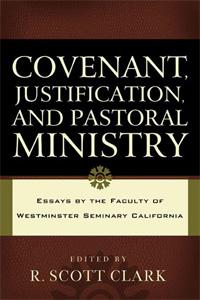
Enough time has passed since the FV matter was addressed decisively, ecclesiastically, in 2007, that not everyone may be equally aware of what it is and why it matters. Here are some resources: Covenant, Justification, and Pastoral Ministry: Essays by the Faculty . . . Continue reading →
Author Archives: R. Scott Clark
See It For Yourself: Piper On Wilson, Baptism, And The FV
Heidelcasts responding to these comments: Heidelcast episode #2: A Gentle Rebuke to Brother John (pt 1) Heidelcast episode #3: A Gentle Rebuke to Brother John (pt 2)
Is John Piper Reformed? Or Holding The Coalition Together (Updated)
This morning my friend Kevin DeYoung (listen to the Office Hours interview with Kevin here) makes some arguments in defense of a broader definition of the adjective Reformed. This question is at the heart of why the HB exists and and why I wrote . . . Continue reading →
For Elders Thinking Of Inviting Arminius Into Their Pulpit
From the time he entered the pastoral ministry, James Arminius (c. 1559–1609) was a controversial figure but he was also a minister in good standing in the Reformed Churches. Despite the intense controversy that his views and teaching generated, views that fractured . . . Continue reading →
What Is True Faith? (2) Assent Is Not Ascent
In part 1 I began to sketch the outline of Heidelberg Catechism Q. 21 on true faith by looking at the three aspects of true faith: knowledge, assent, and trust. In this post I want to consider the second aspect of true . . . Continue reading →
Recursos Reformados
Presbiteriano Reformado La Necessidad de Reforma la Iglesia Literatura Reformada Fundacion Editorial de Literatura Reformada Recursos de Mateo Leighton Confraternidad Latinoamericanade Iglesias Reformadas Reformando la Educación Cristiana para el Tercer Milenio Documentos y Declaraciones Confraternidad Latinoamericanade Iglesias Reformadas Reformando la Educación Cristiana . . . Continue reading →
Office Hours: Darryl Hart On The Global History Of Calvinism
This past summer Yale University Press released Darryl Hart’s Calvinism: A History. Darryl is Adjunct Professor of Church History at WSC, where he served as Academic Dean from 2000–03. He is Visiting Professor of History at Hillsdale College. This is a significant . . . Continue reading →
HB Resources
There are six years of resources on the HB and several ways to access those resources. One is the categories. Another is to use the search function (or google site search—site:heidelblog.net search term). Another way to use the HB is to access the archives, which shows the HB by years, months, and categories. Thanks for your support.
Jordan Westerkamp Makes THE Catch!
Another Way To Connect With The HB
I’ve added a way to follow the Twitter feed. It’s on the bottom right of the HB home page. Why? Because you have nothing else to do? I don’t know. Because it’s there. I do post links there that appear on the . . . Continue reading →
Reformation Day 2013: A Convict, A Commentator, And A Catechism
The good folk at Escondido URC invited me to speak for their Reformation Day celebration. Since it’s the 450th anniversary of the Heidelberg Catechism (this is the Heidelblog, after all) I spoke on the some of the personalities behind the catechism and . . . Continue reading →
The Freedom of the Christian Man (3)
Luther at the Diet of Worms
Part 2. On 18 April 1521 Martin Luther stood before civil and ecclesiastical authorities at the Diet (Riechstag) of Worms. Heiko Oberman translated Luther’s famous speech thus: “Unless I am convinced by the testimony of the Holy Scriptures or by evident reason—for I . . . Continue reading →
Freedom of the Christian Man (2)
Part 1. Many of us have spent time in forms of Christianity that are very strong on rules and slavery and very weak on grace and freedom. By “rules and slavery” I refer to the imposition of man-made rules by which sanctity . . . Continue reading →
Freedom of the Christian Man (1)
There is a great lot of talk in the evangelical and Reformed world(s) about sola Scriptura but one has the growing sense that not only is the Reformation scripture principle not well understood (e.g., it is often misconstrued as an endorsement of . . . Continue reading →
A Response To Rachel Held Evans Regarding Wilson And The Definition Of “Reformed”
Jonathan Merritt published a critique of Doug Wilson this morning on his Religion News Service. For younger readers, who might not remember the Federal Vision (FV) controversy, Wilson is the leader of the de facto denominational home of the FV, the Communion of . . . Continue reading →
What Is True Faith? (pt 1) We Must Know What We Must Know
One of our favorite television shows is set in NYC and revolves around an Irish Roman-Catholic family in law enforcement. It’s a kind of book end to the Duck Dynasty. Like the latter, it features a strong family with a strong religious . . . Continue reading →
Mystery Unveiled: The Crisis of the Trinity in Early Modern England
In the Reformation and in the period of Reformed orthodoxy, there was no question whether the Christian faith is true. There were great and important questions debated between the Reformed churches and theologians with the Roman communion, the Lutherans, the Anabaptists, and . . . Continue reading →
Grammar Guerrilla: Hopefully and Hopeful
This one will not be easy to change but it is easy enough to understand. Hopefully is an adverb, a word that modifies a verb (an action word). Thus, a correct usage would be: “Hopefully, he rose to address the assembly.” In . . . Continue reading →
The Intoxicating Power Of Moral Superiority
A while back some of us were discussing the problem of political correctness on university campuses, freedom of thought and speech, and speech codes. If universities were meant to be places of open enquiry, where theories may be proposed and debated, then . . . Continue reading →

The Gnostic Dualism Of The God Of Niceness
Dave writes to ask how we should respond to this: “I embrace the all-loving God of the New Testament and not the mean pompous God of the Old Testament”? We should respond to this proposition the way Christians have done since the . . . Continue reading →