
He that knowledgeth not himself to be under the bishop of Rome, and that the bishop of Rome is ordained by God to have primacy over all the world, is an heretic, and cannot be saved, nor is not of the flock . . . Continue reading →
HeidelQuote
HeidelQuote
He that knowledgeth not himself to be under the bishop of Rome, and that the bishop of Rome is ordained by God to have primacy over all the world, is an heretic, and cannot be saved, nor is not of the flock . . . Continue reading →

Willem van Asselt, Irena Backus, John Witte Jr, Carl Trueman and others (including John Fesko and myself) are among those contributing to A Companion to Reformed Orthodoxy by Brill. If you’re interested in the academic study of the history of Reformed theology . . . Continue reading →

Colin raised this question a while back on Unashamed Workman. He asked for comments and, as Mike had just touched on this during the Westminster Seminary California Missional and Reformed Conference, I piped up: Hi Colin, This business of “living the gospel” . . . Continue reading →
HeidelQuote
1. When, however, they are confuted from the Scriptures, they turn round and accuse these same Scriptures, as if they were not correct, nor of authority, and [assert] that they are ambiguous, and that the truth cannot be extracted from them by . . . Continue reading →
Heidelcast

Many years ago a fellow I knew used to practice what he called “evangelism” by asking people, “Do you know the way to [the local amusement park]?” Nice, irrepressibly helpful Midwesterners they were, folk would always stop to give directions. Then, our . . . Continue reading →
Heidelcast
The Church of Steel vs A Cross of Wood In downtown San Diego there is a storefront on Broadway which advertises itself as the “Church of Steel.” I found an interview with the proprietor (minister?) of this “church” and it is enlightening. . . . Continue reading →
Re-posted from c. 2007 Dateline Paris, 1534.© Paris News ServiceBy Guy LaFontaine Jean Calvin, 25, of Noyon, a leading scholar of the classics and law student in the University of Paris, has reportedly converted to the evangelical cause. A classicist with a . . . Continue reading →
The Reformed confessions distinguish between the elements of worship and the circumstances of worship. In Westminster Confession 21 we say, “…the acceptable way of worshiping the true God is instituted by himself, and so limited by his own revealed will, that he . . . Continue reading →

Paul Miller writes: I was wrong. One year ago I left the internet. I thought it was making me unproductive. I thought it lacked meaning. I thought it was “corrupting my soul.” It’s a been a year now since I “surfed the . . . Continue reading →

Curt writes to ask, I have a question. In “A Brief History of Covenant Theology” You write: For most of the Medieval period, the Western (Latin) church and the major theologians agreed that God says what he says about us, because we . . . Continue reading →
re-posted from May 2007. In light of the discussion prompted by the brief snippet from Calvin on instruments this seems appropriate.— Friday, in the Medieval-Reformation course I gave a lecture on Calvin’s doctrine of worship during which a student asked about instruments. . . . Continue reading →
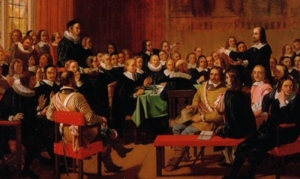
In reaction to Rick Phillips’ critique of a response by a Federal Visionist to his (then) presbytery, one of the proponents of the Federal Vision made the following argument: … Surely, we all know there’s a difference between how we use terms . . . Continue reading →
HeidelQuote
IV. Second, they falsely argue from the ignorance of a thing to its negation, as if it was necessary for a thing not to be because it is not known. And yet the truth of the thing is to be measured from . . . Continue reading →
It’s being argued (on discussion lists and in private emails) that there was never any mainstream of Reformed theology in the 16th and 17th centuries. The proof? Some cat or other emails to say, “here’s an sentence from this important 17th century . . . Continue reading →
prepared by Patrick J. O’ Banion M A. (Westminster Seminary California), 2001 Orthodox Reformed Writers Available in the Early English Books (all reel numbers are from the 1475-1640 series unless otherwise noted) Alsted: The beloved city: the saints reign on earth for . . . Continue reading →

Petrus van Mastricht (1630–1706) wrote one of the most important, most mature theological works the period of high orthodoxy (which has nothing to do with the new pot laws in Colorado and Washington State), the Theoretico-Practica Theologia. Todd Rester, who translated and . . . Continue reading →
The congregation was facing particular pressures and Hebrews 10 reflects this. The pastor wrote, “But recall the former days when, after you were enlightened, you endured a hard struggle with sufferings, sometimes being publicly exposed to reproach and affliction, and sometimes being . . . Continue reading →

(HT: Mike Opelka) In this video, Lesbian activist Masha Gessen makes explicit what’s been known underground in the homosexual community for a long time: Homosexual marriage is not about civil rights. It never has been. Camille Paglia exposed that story in the . . . Continue reading →

Until very recently presidents and presidential candidates, even if they didn’t believe it, had to say that they were in favor of marriage as historically understood and opposed to homosexual marriage. Now, they don’t. What changed and how did that change come . . . Continue reading →
Heidelcast
A correspondent writes to about an Anglican minister who advised the poor, who are starving, who’ve somehow fallen through the extensive British social safety net, among his congregation, to shoplift rather than commit burglary. He asked them not to steal from small . . . Continue reading →