
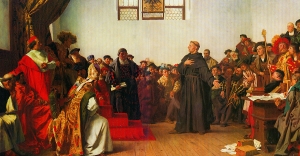
In April 1521, when Martin Luther stood before the powers of this world at the Diet of Worms, he did so on the basis of the sole, unique, and final authority of God’s Word. Luther confessed that his conscience was bound by . . . Continue reading →
In April 1521, when Martin Luther stood before the powers of this world at the Diet of Worms, he did so on the basis of the sole, unique, and final authority of God’s Word. Luther confessed that his conscience was bound by . . . Continue reading →
THERE is no day commanded in scripture to be kept holy under the gospel but the Lord’s day, which is the Christian Sabbath. Festival days, vulgarly called Holy-days, having no warrant in the word of God, are not to be continued. Nevertheless, . . . Continue reading →

It is a general, if unstated, assumption among moderns that whatever the causes of the Reformation might have been, they must be long past. Often, however, that assumption is ill-founded. In fact, the fundamental causes for the Reformation (e.g., the Roman denial . . . Continue reading →

This past Lord’s Day morning we began the new week by hearing a sermon, an exposition of God’s Word and a proclamation of the law and the gospel. In our congregation we heard a sermon from the first part of Exodus 32. . . . Continue reading →
Let us now see what is meant by the due worship of God. Its chief foundation is to acknowledge Him to be, as He is, the only source of all virtue, justice, holiness, wisdom, truth, power, goodness, mercy, life, and salvation; in . . . Continue reading →
Then Hezekiah the king rose early and gathered the officials of the city and went up to the house of Yahweh. And they brought seven bulls, seven rams, seven lambs, and seven male goats for a sin offering for the kingdom and . . . Continue reading →
Minority Report of the Committee on Song in the Public Worship of God Submitted to the Fourteenth General Assembly of the Orthodox Presbyterian Church.The above-mentioned committee presented to the Thirteenth General Assembly a report bearing upon the question of the regulative principle . . . Continue reading →

When we think about John Murray we might think first of his defense of the biblical doctrine of The Imputation of Adam’s Sin or we might think of his judicious application of Scripture in Principles of Conduct. Others might think of Mr . . . Continue reading →
The rule of faith (regula fidei), indeed, is altogether one, alone immoveable and irreformable; the rule, to wit, of believing in one only God omnipotent, the Creator of the universe, and His Son Jesus Christ, born of the Virgin Mary, crucified under . . . Continue reading →
Obs. IV. That our utmost care and diligence in the consideration of the mind of God are required in all that we do about his worship.—There is nothing wherein men for the most part are more careless. Some suppose it belongs unto . . . Continue reading →
Another use of the moral law is, that it may be a rule of divine worship and of a Christian life. “Thy word is a lamp unto my feet, and a light unto my path.” “I will put my law in their . . . Continue reading →
The second point, is the rule of the worship: and that is, That nothing may go under the name of the worship of God, which he has not ordained in his own word, and commanded to us as his own worship. For . . . Continue reading →
Now, even at this very time, when we are seeking and searching to find out the misdeeds on account of which God punishes us, and in what we have offended, you allege against us, that we have changed the divine service, and . . . Continue reading →
Now, when the true God is known, and the certain and sure rule of worshipping him is understood, there is nothing more equal than that which God commandeth in his law, to wit, that those who bear rule with power (having abolished . . . Continue reading →
Hereby we may easily gather how frivolous the boasting of the Papists is, whilst that they carelessly thunder out with full mouth the name of the Church; whereas, notwithstanding, they have most filthily corrupted the doctrine of the apostles. For if it . . . Continue reading →
Our fathers worshipped in this mountain. The Samaritans at that time did, as we learn from the words of the woman, what is customary with those who have revolted from true godliness, to seek to shield themselves by the examples of the . . . Continue reading →
On the second point, when God is worshipped by inventions of men, he condemns this “fear” as superstitious, though men endeavour to cloak it under a plausible pretence of religion, or devotion, or reverence. He assigns the reason, that it “hath been . . . Continue reading →
I have also no difficulty in conceding to you that there is nothing more perilous to our salvation than a distorted and perverse worship of God. The primary rudiments by which we are wont to train to piety those whom we wish . . . Continue reading →
We say that it is a superstition to esteem one day more holy than another, or to think that to abstain from labour is something which, in itself, pleases God (Rom 14:5, 6; Col 2:16, 17). But, following what the Lord has . . . Continue reading →

The Christmas season is nearing its climax. As the shopping ebbs and the work schedule slows a bit (for some anyway—remember in your prayers your local police and firefighters as this can be a difficult time for them) it gives us opportunity . . . Continue reading →