A Prison Letter From Huguenot Marie Durand

The “French Religious Wars” describes a series of eight civil wars fought out between 1562 and 1598. An estimated three million people perished, fifteen percent of the French population. Although the antagonists wore their inherited religious labels of “Protestant” or “Catholic,” social . . . Continue reading →

Discounted To $2.99: The Kindle Version Of Olevianus’ Exposition Of The Apostles’ Creed

An Exposition of the Apostles’ Creed

It is good to see evangelicals rediscovering the Great Christian Tradition, i.e., the broad stream of ecumenical (universal) Christian truth represented by the ecumenical creeds. The confessional Reformed churches, however, have always, from the beginning of the Reformation, been aware of and . . . Continue reading →

Read Thomas And See For Yourself

I was led to think that Thomas had been more or less mugged by Aristotle, indeed, I was given to think that Thomas was the source of much that ailed Christianity. In one tour de force, Van Til jumps from Aristotle, to . . . Continue reading →

NoCo Radio Is Reading Beza

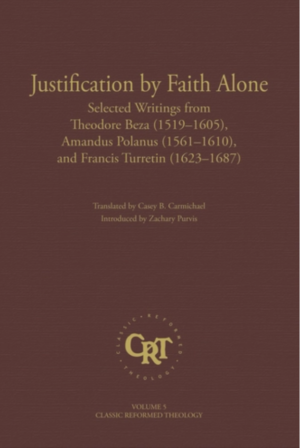
Theodore Beza (1519–1605) was a remarkably long-lived and significant theologian in the Reformed tradition. He is best known as a theologian but he was an advisor to Calvin and the Reformed churches across Europe and the British Isles. He was more than . . . Continue reading →

New In Print: Petrus van Mastricht, Theoretical-Practical Theology vol. 3: The Works of God And The Fall Of Man

Petrus van Mastricht (1630–1706) was among the more important Reformed theologians of the later 17th century. According to Richard Muller, in van Mastricht we see Reformed orthodoxy and scholasticism coming to its high point technically. So students of the history of Reformed . . . Continue reading →

What Did Geerhardus Vos Think He Was Doing?

Although Geerhardus Vos is best known as a biblical theologian, this is not an essay about biblical theology. Nor does it deal with his well-known 1894 Princeton inaugural address. It is instead a reflection on important aspects of the larger theological method that . . . Continue reading →

William Perkins On Justification (2)

In connection with Trent and Bellarmine’s stance on purgatory and the sacrifice of the Mass was Rome’s doctrine of a second justification. Bellarmine’s Scriptural basis for a second justification was Romans 3—which he saw as the first justification, and James 2—which he saw as the second justification. For Perkins, James 2 was for the justified because of Christ, “outward testimonies of the truth of our faith and profession, proving that the grace of our hearts is not in hypocrisy, but in truth and sincerity.” In other words, James 2 spoke not of justification in the same sense as Paul in Romans, but in a completely different sense, scope, and design, James 2:21 is in the demonstrative for Abraham’s “works did testify that his faith was true and sincere. Continue reading →

William Perkins On Justification

Perkins objected to Rome’s sacrifice of the Mass. For Perkins, this doctrine was attached to erroneous views of Christology, Christ’s propitiatory suffering unto death, and in turn the doctrine of justification. One of Perkins’s clearest Christological statements is found in his treatise, A Warning Against the Idolatry of the Last Times (1601), where he wrote, “For He in one person is perfect God and perfect man, our only Redeemer all-sufficient in Himself, and therefore perfect king, priest, prophet; without either partner or fellow in the work of man’s salvation.” Continue reading →