I. The question concerning fundamental articles is difficult and important. It has been discussed by many who have erred both in defect and in excess. The Socinians err in defect who admit very few fundamentals (and those only practical, theoretical being almost . . . Continue reading →
Recovering the Reformed Confession
With Presbycast On The Christian Sabbath And Intinction

Walter Sobchak is a memorable character in the brilliant Coen Brothers’ film, The Big Lebowski. For all that he is not (e.g., careful about his use of certain a Anglo-Saxon profanity), Walter is faithful to his commitment to Shabbos (the Yiddish term . . . Continue reading →
With The Daily Brew On Church History And Confessions

It was good to sit down this week with Adam and Jeremy on The Daily Brew discuss the importance of church history and confessions. We talked about ways to get started studying church history, some of my favorite biographies, the value of . . . Continue reading →
In Defense Of Religion

One frequently sees the sentiment “I am not religious, I am a Christian” or something like this. This notion manifests itself in a variety of ways. For example, over the last several years we have seen the gradual abandonment of traditional Christian . . . Continue reading →
With Rob Ham On Recovering The Reformed Confession

Rob is pastor of Keystone Heights Presbyterian Church in, wait for it, Keystone Heights, FL (northeast of Gainesville). He hosts a daily podcast, which is available via the church’s website or sermon audio or on iTunes. Rob is a former student of . . . Continue reading →
Reformed Piety And Practice

When Martin Luther (1483–1546) entered the Augustinian convent at Erfurt in 1505, it was a considered decision and the fulfillment of a vow he had made when he cried, “St. Anne, help me! I will become a monk.” So he did. Luther . . . Continue reading →
What David Saw Within Anglicanism
There was sometimes an expressed commitment to certain iconic traditions of Anglicanism that seemed to supersede the commitment to the gospel message and the primacy of Scripture. I began to perceive that many of Episcopalian background regard the traditions of Anglicanism as . . . Continue reading →
Heidelcast 125: I Am That I Am (3)—More On The Categorical Distinction

So far in this series we have been talking about what I call the categorical distinction, i.e., the Creator/creature distinction. At the 1518 Heidelberg Disputation Martin Luther unveiled what he called his theology of the cross, (theologia crucis) against what he described . . . Continue reading →
Turretin On The Five Marks Of The Fundamental Articles Of The Christian Religion
XIX. The following things must belong to fundamental articles: (1) that they be catholic, for the things necessary for the salvation of everyone are required for a universal faith (according to the Athanasian Creed “whoever wishes to be saved must above all . . . Continue reading →
Sola Scriptura Protects Christian Liberty
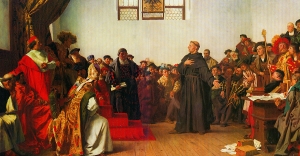
In April 1521, when Martin Luther stood before the powers of this world at the Diet of Worms, he did so on the basis of the sole, unique, and final authority of God’s Word. Luther confessed that his conscience was bound by . . . Continue reading →
The Reformed Defense Of Christian Liberty In 1530
When, therefore, we saw very evidently that the chief men in the Church beyond the authority of Scripture assumed this authority so to enjoin fasts as to bind men’s consciences, we allowed consciences to be freed from these snares, but by the . . . Continue reading →
The Reformed Reject Lent In Basle In 1534
Article XI Concerning Things Commanded and Not Commanded Of self law (Autonomia) or power in the conscience, Relinquished to Christ alone in the church We confess that no one ought to command in any manner that which Christ has not commanded; also, . . . Continue reading →
A Wonderful Illustration Of The Necessity Of An Objective Definition Of Reformed
Trevin Wax and David Fitch have been in a dialogue in which each of them has published a post expressing appreciation for the other’s tradition. Wax identifies as Reformed and Fitch as Anabaptist. The reader can draw his own conclusions as to . . . Continue reading →
Back In Print: Beza On The Christian Faith

Theodore Beza (1519–1605) was one of the most significant Reformed theologians in the late 16th and early 17th centuries. He was a humanist (a classics scholar), Calvin’s successor in Geneva, a New Testament scholar, minister, and a teacher in the Genevan Academy. . . . Continue reading →
Volume 3 Of Perkins’ Works Available Now

William Perkins (1558–1602) is one of the most important of the English Reformed writers of the late 16th and early 17th centuries but, until recently, his works were mostly unavailable. Until this new series by RHB, his works had been out of . . . Continue reading →
A New Online Resource For Bible Study

Travis Fentiman wrote to let me know about a resource site he has compiled which is built on Spurgeon’s recommended list of commentaries and upon resources such as the Post-Reformation Digital Library (PRDL). It is a gateway to older, online biblical commentaries. . . . Continue reading →
When Confessional P & R Congregations Do Not Exist Or Disappoint

A reader writes: “I’ve followed your blog and podcast for a while now. I have not been a Reformed/Presbyterian for very long, but I do know that I want to be a part of a specific congregation that is committed to confessional . . . Continue reading →
Which Classic Reformed Works To Read In English?

Rob writes, Listening to you on the Heidelblog/Heidelcast and Office Hours, you have given me a enormous desire to read more “classic reformed theology.” I am currently reading Turretin’s Institutes and I would love to know who are some more classic reformed . . . Continue reading →
With The Reformed Collective On Reformed Piety

Piety. It is a short but it is a very important word in the Reformed tradition. It is Latin word, pietas, which, in classical usage referred to one’s duty toward the gods and toward one’s parents. In traditional Christian usage it has . . . Continue reading →
Help Recover One Of The Most Important (And Neglected) Reformed Theologians For English Readers

Gijsbertus Voetius (1589–1676) is perhaps the linchpin of Dutch Reformed theology in the 17th century. To shift metaphors, he is the Grand Central Station of Reformed orthodoxy in the Netherlands. In one way or another all the various trains seem to run . . . Continue reading →