Sometime back the question was raised: We know that there are at least two categories of people within Scripture, the elect, and the non-elect. However, it might be apparent that there is a third class of people, those who have taken the . . . Continue reading →
Idea: Let’s Try Every Way But Christ’s Way
Thanks to a link by Justin Taylor, I read an article by Nancy Morganthaler this morning that is disturbing on so many levels, I hardly know where to begin. I begin with confession: I tried and failed miserably “to do the church . . . Continue reading →
More On The Second Service
I am getting some interesting feedback on the earlier post regarding the second service. A few thoughts: I discuss this at length in the forthcoming volume, Recovering the Reformed Confession. So I don’t want to repeat all of that material here. Some . . . Continue reading →
Why A Second Service?
Here is a link to an excellent piece by G. H. Visscher. One of the most disturbing trends of modern Reformed church life is the disappearance of the second service. What does it mean? It means at least two things: 1) we’ve . . . Continue reading →
Lex Credendi
The medievals had a slogan, “The law of praying is the law of believing.” It means, “If we can change liturgy, we can change what folk believe.” This axiom means that whoever controls the liturgy controls the future of the church, humanly . . . Continue reading →
Talking Past One Another?
I didn’t know Rich Mouw has a blog. Indeed, a number of evangelical scholars maintain blogs, including John Stackhouse (blog no longer available). In a recent entry he responded to criticism of his essay in The Christian Century proposing that Protestant re-think . . . Continue reading →
Review: The Story of Christian Theology: By Roger E. Olson
Intervarsity Press, 1999. 652 pp. $34.99
Historical theology is an important part of the process of deciding who we are, what we believe and consequently how we will behave. For confessional Protestants, the past is not absolutely definitive, since all theologies besides God’s revealed word err, but its . . . Continue reading →
Misery (Heidelberg Catechism, Question 3)
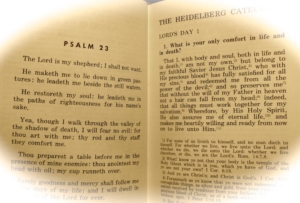
If I may start with something I posted a few weeks ago: The English noun, “misery” is probably derived from the Latin verb misereo, “to pity.” The Latin adjective miser means “wretched.” In our translation, the noun “misery” (German, Das Elend; Latin, . . . Continue reading →
(Reformed) Christianity and (Quasi-Reformed) Revisionism
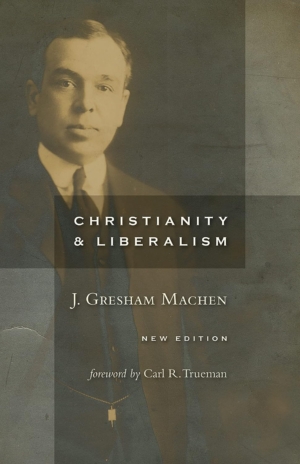
In his brilliant work, Christianity and Liberalism (1923), J. Gresham Machen called for the “liberals” (many of whom could just as aptly be called broad evangelicals) to be honest about their views and to leave the Presbyterian Church. Thirteen years later, it . . . Continue reading →
The Myth Of Influence
In the March 7, 1998, issue of the Los Angeles Times, the “Religion” section featured an article entitled, “L.A.-Area Seminary Teachers Gather to Ponder the Truth.” For the fourth year, the Skirball Institute on American Values drew five seminaries together for discussion: . . . Continue reading →
Theses Theologicae (Theological Propositions)
Introduction Since the medieval period, theologians have stated theology in the form of brief, sometimes provocative, propositions to be discussed. 1. Prolegomena Theology requires proper distinctions. The Protestant scholastics distinguished properly between archetypal (theology as God knows it in himself) and ectypal . . . Continue reading →
El Israel de Dios
Traducción al español: David Barceló, abril 2002. Introducción Hay mucho más concerniente a los “tiempos del fin” o últimas cosas (Escatología) de lo que nosotros decimos que realmente sucede en los últimos días. Nuestra escatología depende estrechamente de nuestra visión de lo . . . Continue reading →
The Presbyterian Controversy: A Review
Bradley Longfield, of Duke University, has written an important book about the struggles surrounding the formation of the OPC in the 1920s-30s. Know Yourself This book is of interest to us for three reasons. First, the OPC is family, and we have . . . Continue reading →