
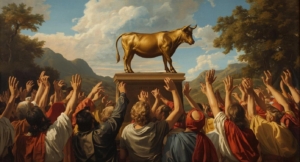
The late German-American political philosopher Eric Voegelin (1901–1985) observed that history is marked by recurring attempts to divinize a fallen created order as a way of escaping the anxiety of fragile and finite existence. He identified in the early church heresy of Gnosticism a paradigm for understanding how private spiritual ambitions are transposed into public political projects—from Constantinianism and medieval Christendom to the totalitarianisms of the modern left and right. Continue reading →
Author: Simon Jooste
Rev. Simon Jooste (PhD, Stellenbosch University) is a former USA Division I tennis player and CPA now living in his native South Africa serving the Reformed Church Southern Suburbs. He has authored Embodiment and Power: the Essential Nature of the Women in Office Debate (2022) and Pilgrim Politics: Crucified Creedalism Under Christ’s Two-Fold Rule (Mentor, 2026).
Justification By Faith And Social Justice By Works (Part 2)
The gospel can be turned into law—even into new religious laws, especially when sweeter fruit is available to stave off the bitter taste of judicial conviction. When fallen creatures turn down contracts with part or all of the moral law, the door invariably opens to various forms of religious innovation, new orders for spiritual justice. Continue reading →
Justification By Faith And Social Justice By Works (Part 1)
Artificial intelligence (AI) stands at the forefront of technological advancement, representing a simulation of the real—a virtual reality. AI systems and bots can imitate humans, even fulfilling aspects of the cultural mandate. Continue reading →
African Reformed Churches: Confessional Reformation In Africa
Why A New Reformed Denomination? Reformed Christians understand the significance of the Reformation and its effect on global Christianity. In Africa, there was an extended series of Reformed missions from the sixteenth to the early twentieth centuries. But this was not the . . . Continue reading →
Hart, Borvan, Lee, And Jooste In Conference August 11–12, 2023: Christianity And Liberal Democracy
D. G. Hart, Dan Borvan, Simon Jooste, and Brian Lee in conference! Continue reading →
“Apartheid” Of Church And State
Editor’s Note: This article originally appeared in the January 2023 Volume 12 / Issue 1 of the Lausanne Global Analysis and is published here with permission. To receive this free bimonthly publication from the Lausanne Movement, subscribe online here. § I am . . . Continue reading →
Review: J. M. Vorster’s The Gift of Life (Part 3): What Kind Of Reformation?
The tensions and inconsistencies that I have attempted to illustrate in this book review beg another question: What kind of reformation is The Gift of Life after? The answer Professor Vorster appears to provide is one of “flourishing personhood” that roots out . . . Continue reading →
Review: J. M. Vorster’s The Gift of Life (Part 2): Postmodern Identity Politics Gets A Galatians 3:28 Makeover
At this point it is worth asking: What informs Professor Vorster’s overarching moral vision? Throughout The Gift of Life, the contention is that definitions of human dignity found in the liberal democratic and human rights traditions can be translated into Christian value . . . Continue reading →
Review: J. M. Vorster’s The Gift of Life (Part 1): Political Liberalism Or Liberation Theology?
North-West University Professor J. M. Vorster’s The Gift of Life: Toward an ethic of human personhood (2021) represents a crowning of his career as a Reformed Pastor, theologian, and ethicist in the South African context.1 I review this volume as a fellow . . . Continue reading →
Paul Re-Forms The Body In Corinth
Embodiment is central to salvation, so is suffering in the body. Without the incarnation, passion, and ongoing enfleshed intercession of Christ, there is no redemption. This was the heartbeat of the apostle Paul’s preaching in ancient Corinth, a city pulsing with ideas . . . Continue reading →
How The Spirituality Of The Church Can Address The Legacy Of Apartheid
As South Africa’s second-largest metropolis (after Johannesburg), Cape Town not only has a rich history but is also a melting pot of scenic views, cuisines, and skin colors. She boasts incredible beauty but also thrombotic veins of prejudice and inequality, which are . . . Continue reading →


