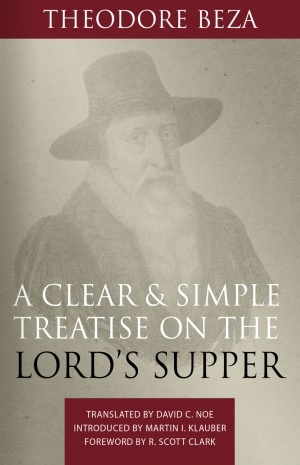
This is an advertisement very needful; because many are apt to skip over the lesson concerning the means (that will fill up this whole treatise) as superfluous and useless. When once they know the nature and excellency of the duties of the . . . Continue reading →
Author: R. Scott Clark
R.Scott Clark is the President of the Heidelberg Reformation Association, the author and editor of, and contributor to several books and the author of many articles. He is professor emeritus of church history and historical theology at Westminster Seminary California, where he taught for 29 years. He also taught at Wheaton College, Reformed Theological Seminary, and Concordia University. He has hosted the Heidelblog since 2007 and the Heidelcast since 2009.
The Wilsonian Legacy: Too Big To Jail
This is the Wilsonian legacy, finally achieved after a century of waiting: the Big Man (or Woman), unanswerable to the law, approved by the population without regard to equality under the law. We now elect our dictators. And they are unanswerable to . . . Continue reading →
What Heresy Is, Who Gets To Say, And Why?
Part of the problem has been that in using the word ‘heresy’ (which I didn’t but do now) we have been talking past each other. Heresy is not a word to be used carelessly and hurled indiscriminately at anyone who dares to . . . Continue reading →
Sanctification Is A Work Of God’s Grace: Resources On Sanctification
It is held by some who think of themselves as evangelical and Reformed that justification is by grace alone (sola gratia) but sanctification is by grace and works, i.e., that it is synergistic. To my great shame, I remember once answering a . . . Continue reading →
The American Declaration Of Independence
IN CONGRESS, July 4, 1776. The unanimous Declaration of the thirteen united States of America, When in the Course of human events, it becomes necessary for one people to dissolve the political bands which have connected them with another, and to assume . . . Continue reading →
The Practical Danger Of “Continuing Prophecy”
When I first met my husband-to-be, it was like a dream come true. We met on a missions trip. He was kind, considerate, actively serving in the church, spiritually mature, and handsome, too. Our friendship grew quickly and within months we were . . . Continue reading →
How The PCA GA Action On The Role Of Women In The Church Appears To One Woman
Editor’s Note: The following is written by a PCA pastor’s wife, who is herself a seminary graduate. In the interests of focusing on issues and not personalities, the writer shall remain anonymous. For obvious reasons, comments on this post are closed. § . . . Continue reading →
Help Les Make “Calvinist”
Open Discussion Leads To Peace. Squelching Dissent Does Not
By the way, I accept it as fair that if a person advocates positions in writing, his ideas may be criticized and disagreed with vigorously—I won’t squeal about spirited and rational public discourse. Indeed, more of that may lead to more peace . . . Continue reading →
Justice Thomas Contra The Majority On Making Up Law As We Go Along
I remain fundamentally opposed to the Court’s abortion jurisprudence. …It is tempting to identify the Court’s invention of a constitutional right to abortion in Roe v. Wade, 410 U. S. 113, as the tipping point that transformed third-party standing doctrine and the . . . Continue reading →
Office Hours: The Holy Spirit And Sola Scriptura
One of the dominant trends in global Christianity is the growth of the Pentecostal and the Charismatic movements. A 2011 study published by the Pew Research Center’s Forum on Religion and Public Life says that more than 500 million Christians globally identify . . . Continue reading →
Strangers And Aliens (21b): Be Not Surprised By Fiery Trials (1 Peter 4:12–19)
12Beloved, do not be surprised at the fiery trial when it comes upon you to test you, as though something strange were happening to you. 13But rejoice insofar as you share Christ’s sufferings, that you may also rejoice and be glad when . . . Continue reading →
Justice Thomas Contra Racial Preference
I join JUSTICE ALITO’s dissent. As JUSTICE ALITO explains, the Court’s decision today is irreconcilable with strict scrutiny, rests on pernicious assumptions about race, and departs from many of our precedents. I write separately to reaffirm that “a State’s use of race . . . Continue reading →
Why This Controversy Now?
During this same time, there was also groundbreaking historical work done by Richard Muller and those who followed in his wake. Muller’s research definitively smashed the “Calvin against the Calvinists” thesis, and his undeniably strong scholarship produced a whole new generation of . . . Continue reading →
Video: Who Are The Reformers? John Calvin
Catecismo De Heidelberg
Cuál es tu único consuelo tanto en la vida como en la muerte? Que yo, con cuerpo y alma, tanto en la vida como en la muerte, no soy dueño de mi vida, sino que pertenezco a mi fiel Salvador Jesucristo, quien . . . Continue reading →
Truly Audacious Proposals
Let us all reflect for a moment on the dramatic significance of Grudem’s claim about eternal generation. What he is saying is that the church catholic has for over 1600 years been affirming theologically and liturgically, as the key ecumenical summary of . . . Continue reading →
Governmental Interpretation Of Religion? A Constitutional Problem
Almost immediately after the attacks on 9/11/2001 federal officials, beginning with the President of the United States, assured the world that the views held by and motivating the attacks by those who perpetrated the attacks did not represent true or genuine Islam. . . . Continue reading →
Calvin’s Letter To Five Missionaries About To Be Martyred For The Gospel
MY VERY DEAR BRETHREN,1—Hitherto I have put off writing to you, fearing that if the letter fell into bad hands, it might give fresh occasion to the enemy to afflict you. And besides, I had been informed how that God wrought so . . . Continue reading →
Note To Evangelicals Revising The Doctrine Of God: The Socinian Vortius Denied Simplicity
Conrad Vorstius also occupies a significant, but nearly entirely negative, place in the development of Reformed orthodox doctrine of the divine attributes. After his successful defense of two of his works, De sancta trinitate (1597), and De personis et officio Christi (1597), . . . Continue reading →