
Now it is certain that in the Law there is prescribed to men a rule by which they ought to regulate their life, so as to obtain salvation in the sight of God. That the Law can do nothing else than condemn, . . . Continue reading →
Justification
The Stone Had Been Rolled Back

When the Sabbath was past, Mary Magdalene, Mary the mother of James, and Salome bought spices, so that they might go and anoint him. And very early on the first day of the week, when the sun had risen, they went to . . . Continue reading →
Hodge On That “Gloomy Doctrine” Versus The Good News
Whether good or bad. That is, whether he did good or evil. Each person will receive according to his deeds, whether good or bad. It is from passages such as this that some American theologians have inferred that the only benefit the . . . Continue reading →
The Consensus Of The Divines, Legalism, And The Covenant Of Works

The charge of legalism against the covenant of works is one of those allegations that seems persuasive at first because we all know that legalism is bad and that grace is good. It is almost instinctive to react to the charge by asserting the graciousness of the covenant of works. That is a trap, however, into which we ought not step. Continue reading →
Why Should I Love God?

The first commandment of God’s holy moral law is unequivocal: “You shall have no other gods before me” (Exodus 2o:3). In the ground (כִּ֣י) of the second commandment Yahweh Elohim declares, “I the LORD your God am a jealous God, visiting the . . . Continue reading →
Buchanan: Nothing New Or True About “Final Justification”
The Protestant doctrine affirms that a sinner is made or constituted righteous by having Christ’s righteousness imputed to him; and that, being thus justified actually, he is also justified declaratively, when his acceptance is proved or attested, so as to be made . . . Continue reading →
There Is Only One Stage Of Justification

In recent years, however, within ostensibly confessional Protestant circles, some have been advocating versions of a two-stage doctrine of justification. One version of this proposal is that we may be said to be justified initially by grace alone, through faith alone but only finally justified on the basis of our sanctification. Some give the whole basis of our final justification to our inherent sanctification and righteousness and others only part of the basis. Continue reading →
Muddying The Distinction Between Justification And Salvation
Biblicism is the attemp to read the bible by itself and by one’s self, i.e., in isolation from the church. Sola scriptura means that Scripture alone is the sole, final authority for faith and life but it does not mean to declare either . . . Continue reading →
Imperative And Indicative; Law And Gospel

James writes to ask, I am trying to work out the Law/Grace distinction, and am having some trouble understanding the imperative/indicative divide. For example, in Acts 3 Peter is preaching what appears to be the gospel in the Temple, and he preaches . . . Continue reading →
Justified Through Our Faithfulness?
Introduction As I mentioned in an earlier post in Romans 2:13 Paul writes, “For it is not the hearers of the law who are righteous before God, but the doers of the law who will be justified” (ESV).1 The chapter begins with . . . Continue reading →
Burying The Lead On Baxter
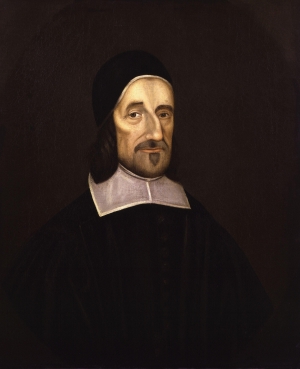
There is a phrase in journalism called “burying the lead” (or, since about 1979, the cloying variant lede). The lead (lede) is the paragraph in which the most important, salient facts are contained. In the old days (c. 1975), the writer was . . . Continue reading →
Perkins: Grace Admits No Partner Or Fellow
[The Galatians] joined the works of the law with Christ and his grace in the cause of their justification and salvation. Here it must be observed that they which make a union of grace and works in the cause of justification are . . . Continue reading →
Hodge: Christ Fulfilled The Conditions Of The Covenant Of Works For Believers
The second consequence attributed to the imputation of Christ’s righteousness, is a title to eternal life. This in the older writers is often expressed by the words “adoption and heirship.” Being made the children of God by faith in Christ Jesus (Gal. . . . Continue reading →
Why Do Christians Do Good Works?
86. Since then we are redeemed from our misery by grace through Christ, without any merit of ours, why should we do good works? Because Christ, having redeemed us by His blood, also renews us by His Holy Spirit after His own . . . Continue reading →
The Question Is Not Whether But Why?
Do Reformed Christians ignore the Epistle of James? Particularly, have those who confess the Reformed theology, piety, and practice been guilty of ignoring James’ teaching in 2:14–17. Whether James has been ignored in recent years is a difficult assessment to make. How . . . Continue reading →
Machen: Salvation Through Faith vs. Salvation Through Love
To say that our faith saves us means that we do not save ourselves even in the slightest measure. Very different would be the case if our salvation was said to be through love…. J. Gresham Machen, What Is Faith? (1946), 173–4.
The Logic Of Fruit As Evidence (2)

“But after a man is justified by faith, now possesses Christ by faith, and knows that He is his righteousness and life, he will certainly not be idle but, like a sound tree, will bear good fruit (Matt. 7:17). For the believer has the Holy Spirit; and where He is, He does not permit a man to be idle but drives him to all the exercises of devotion, to the love of God, to patience in affliction, to prayer, to thanksgiving, and to the practice of love toward all men.”
—Luther Continue reading →
What The Socinians Denied And Taught On Faith And Justification
1. That justifying faith, or that faith whereby we are justified, is our receiving of Christ as our Lord and Saviour, trusting in him and yielding obedience to him. 2. That faith, in justifying, is not to be considered as a hand . . . Continue reading →
The Logic Of Fruit As Evidence (1)
The Patristic Period One of the earliest concerns of the Christian church, beginning with the apostles and intensifying through the patristic and medieval periods, was that those who profess the Christian faith should live in a way befitting their profession of faith. . . . Continue reading →
Perkins: As Signs Thereof
Nothing within man, and nothing that man can do, either in nature, or by grace, concurreth to the act of justification before God, as any cause thereof, either efficient, material, formal, or final, but faith alone; all other gifts and graces, as . . . Continue reading →