
Redemption is a real deliverance from the evils of punishment, which is actually nothing but the carrying out of the sentence of justification. For in justification we are pronounced just and awarded the judgement of life. In glorification the life that results . . . Continue reading →
Justification
Heidelcast 76: Was The Marrow Antinomian?

This is 13th and final part of the our series, nomism, antinomianism and The Marrow of Modern Divinity. If you’re just joining us, you can start at the beginning with episode 58. Why this series? Because The Marrow was an important classic . . . Continue reading →
Witsius On The Relations Between The Covenants Works And Grace
XV. In Scripture, we find two covenants of God with man: the Covenant of Works, otherwise called, the Covenant of Nature, or the Legal and the Covenant of Grace. The apostle teacheth us this distinction, Rom. 3:27, where he mentions the law . . . Continue reading →
Mr Murray Distinguishes Law And Gospel
Recognition of this datum of awful sanctity, and republication of it with conviction and authority is the only path of repentance and restoration. As we recognize the awful sanctity that surrounds the law, we shall certainly be crushed with a sense of . . . Continue reading →
Imputation Works Both Ways
Even so, the magisterium has some explaining to do if you can swallow the idea that humans come into the world with the guilt of Adam’s sinful estate and then object to Protestants drawing a line between the imputation of Adam’s sin . . . Continue reading →
We Never Graduate
I don’t think Paul is saying that he doesn’t offer his members unto righteousness or that he doesn’t make efforts to resist sin and obey God’s law. Could it be it’s just that he (we) never graduated from needing the sufficiency of . . . Continue reading →
Heidelcast 70: Nomism And Antinomianism (9)
The issue before this week is this: The nomist (i.e., the legalist) will frequently deny that he is a legalist. We can even get the nomist to profess orthodox things about the doctrine of justification but here’s an acid test—by the way . . . Continue reading →
R. C. Sproul On Romans 8:4–5
Why? in order that the righteous requirements of the law might be fully met in us, who do not live according to the sinful nature but according to the Spirit (verse 4). Christ did not only come to set us free from . . . Continue reading →
Is Faith A Virtue?

David asks, I know that we would say that faith is an instrument whereby we receive Christ’s imputed righteousness, but is there some biblical or theological reason why we would not want to say that faith is also a virtue? Can’t faith . . . Continue reading →
The Gospel To Diognetus (c. 150 AD)
[God] himself took on him the burden of our iniquities, he gave his own Son as a ransom for us, the Holy One for transgressors, the blameless one for the wicked, the righteous one for the unrighteous, the incorruptible one for the . . . Continue reading →
Machen: Christ Is All Or Nothing
But what was the difference between the teaching of Paul and the teaching of the Judaizers ? What was it that gave rise to the stupendous polemic of the Epistle to the Galatians? To the modern Church the difference would have seemed . . . Continue reading →
Mercy Musings: Psalm 5

Some thoughts from Psalm 5 this morning. I was especially struck by the first seven verses. 1Hearken to my words, O Lord, attend to my cry. 2Attend to the voice of my supplication, my King, and my God: for to thee, O . . . Continue reading →
Justification By Faith Alone Is A Refuge For Sinners
Since Paul knew that justification of faith is a refuge for those who lack righteousness of their own [cf. Romans chapter 5], he boldly infers that all who are justified by faith are excluded from works righteousness. But since it is certain . . . Continue reading →
Does Baptism Save?

Merrit asks this question. “Two friends and I have been talking about this verse (1 Peter 3:21) and passage for quite some time today. The more we seem to talk about it the more confused I seem to get about it.” Merritt, . . . Continue reading →
Calvin On Freedom From Bondage To The Law
Yet, when Paul speaks of the law creating servitude, he is speaking here of the way in which the Galatians misapplied the law… Furthermore, we believe that it is impossible to keep the law of God, but that the law simply reveals . . . Continue reading →
Calvin On Romans 8:4
verse 4. That the justification of the law might be fulfilled, etc. They who understand that the renewed, by the Spirit of Christ, fulfil the law, introduce a gloss wholly alien to the meaning of Paul; for the faithful, while they sojourn . . . Continue reading →
Office Hours: Sanctification And The Fruit Of The Spirit

If you’ve ever planted anything you did so because you hoped that what you planted would grow. When farmers plant seeds, they do so because the expect those seeds to die and to produce a new plant and from that plant new . . . Continue reading →
Yes There Is A Reformed Doctrine Of Justification
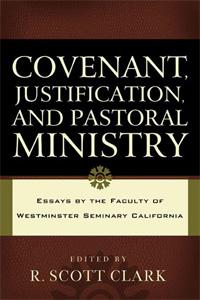
Recently I responded to John Armstrong’s post on the TIME magazine new Calvinist discussion. In his reply, John makes this startling claim: There is no monolithic Reformed voice on justification (especially re: imputation) and I would be very happy if we allowed a . . . Continue reading →
Charles Hodge On Romans 8:4
Verse 4. That the righteousness of the law might be fulfilled in us, &c. This verse expresses the design of God in sending his Son, and in condemning sin the flesh. He did thus condemn it, ἵνα, in order that the righteousness . . . Continue reading →
Calvin On Sanctification As An Effect Of Justification

Concerning the meaning of the phrase “sanctification has its ground in justification,” some out there in bloggo-land may be getting hung up on the term ground and reading more into to it than is warranted. Certainly there is no justification or sanctification . . . Continue reading →