
[God] himself took on him the burden of our iniquities, he gave his own Son as a ransom for us, the Holy One for transgressors, the blameless one for the wicked, the righteous one for the unrighteous, the incorruptible one for the . . . Continue reading →
Author Archives: R. Scott Clark
Facientibus Quod In Se Est Deus Non Denegat Gratiam

“To those who do what lies within them God denies not grace.” My students sometimes wonder why I make them memorize this late-medieval expression associated with a Franciscan theologian. This is why: (HT: Nick Davis)
Machen: Christ Is All Or Nothing
But what was the difference between the teaching of Paul and the teaching of the Judaizers ? What was it that gave rise to the stupendous polemic of the Epistle to the Galatians? To the modern Church the difference would have seemed . . . Continue reading →
Justification By Faith Alone Is A Refuge For Sinners
Since Paul knew that justification of faith is a refuge for those who lack righteousness of their own [cf. Romans chapter 5], he boldly infers that all who are justified by faith are excluded from works righteousness. But since it is certain . . . Continue reading →
Does Baptism Save?

Merrit asks this question. “Two friends and I have been talking about this verse (1 Peter 3:21) and passage for quite some time today. The more we seem to talk about it the more confused I seem to get about it.” Merritt, . . . Continue reading →
Calvin On Freedom From Bondage To The Law
Yet, when Paul speaks of the law creating servitude, he is speaking here of the way in which the Galatians misapplied the law… Furthermore, we believe that it is impossible to keep the law of God, but that the law simply reveals . . . Continue reading →
Calvin On Romans 8:4
verse 4. That the justification of the law might be fulfilled, etc. They who understand that the renewed, by the Spirit of Christ, fulfil the law, introduce a gloss wholly alien to the meaning of Paul; for the faithful, while they sojourn . . . Continue reading →
Office Hours: Sanctification And The Fruit Of The Spirit

If you’ve ever planted anything you did so because you hoped that what you planted would grow. When farmers plant seeds, they do so because the expect those seeds to die and to produce a new plant and from that plant new . . . Continue reading →
Yes There Is A Reformed Doctrine Of Justification
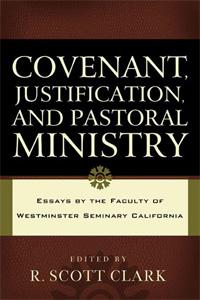
Recently I responded to John Armstrong’s post on the TIME magazine new Calvinist discussion. In his reply, John makes this startling claim: There is no monolithic Reformed voice on justification (especially re: imputation) and I would be very happy if we allowed a . . . Continue reading →
Charles Hodge On Romans 8:4
Verse 4. That the righteousness of the law might be fulfilled in us, &c. This verse expresses the design of God in sending his Son, and in condemning sin the flesh. He did thus condemn it, ἵνα, in order that the righteousness . . . Continue reading →
Calvin: People Have Never Liked The Regulative Principle
I know how difficult it is to persuade the world that God disapproves of all modes of worship not expressly sanctioned by His Word. The opposite persuasion which cleaves to them, being seated, as it were, in their very bones and marrow, . . . Continue reading →
Calvin: Reformed Churches and Ministry Founded on Luther
We maintain to start with that, when God raised up Luther and others, who held forth a torch to light us into the way of salvation on on whose ministry our churches are founded and built, those heads of doctrine in which . . . Continue reading →
Don’t Just Stand There. Come On In!

Kevin DeYoung writes about a conference just held at his congregation with Collin Hansen. He makes a couple of points to which I want to respond. As a minister who has spent a fair bit of time calling people to Christ and . . . Continue reading →
Calvin On God’s Gracious Acceptance Of Our Works In Christ
Not For Justification
In this way we can admit not only that there is a partial righteousness in works (as our adversaries maintain), but that they are approved by God as if they were absolutely perfect. If we remember on what foundation this is rested, . . . Continue reading →
Candychism

Years ago Leonard Coppes wrote an essay in the OPC magazine, New Horizons, on catechizing children. He called it “candychism.” In it he advocated rewarding children who memorize a catechism question and answer. To anticipate a frequent objection: No this isn’t crass . . . Continue reading →
Calvin’s Prayer For Sanctification
Grant, Almighty God, that as thou dost train us up with so much diligence and assiduous care, and regard us as dear and precious like an hereditary vine, – O grant, that we may not bring forth wild grapes, and that our . . . Continue reading →
Calvin On The Image Of God In Man
In this way only we attain to what is not to say difficult but altogether against nature, to love those that hate us, render good for evil, and blessing for cursing, remembering that we are not to reflect on the wickedness of . . . Continue reading →
Lewis: Living In A Society Of Possible Gods
It is a serious thing to live in a society of possible gods and goddesses, and to remember that the dullest and most uninteresting person you can talk to may one day be a creature which, if you saw it now, you . . . Continue reading →
Every Day Is Father’s Day For Christians

Q. 26. What do you believe you when thou say, “I believe in God the Father, Almighty, Maker of heaven and earth”? That the eternal Father of our Lord Jesus Christ, who of nothing made heaven and earth with all that in . . . Continue reading →
Law And Gospel In A Pastoral Context
DATHENUS: Just as this is very comforting, so it also is certain and true. For this is what Paul is teaching us with these similar words, namely, that “by the deeds of the law no flesh shall justified in his sight: for . . . Continue reading →